Eisbock: The Art of Freeze Distillation.
I still remember the first time I opened a bottle of Schneider Aventinus Eisbock. I’d been brewing for about three years at that point and thought I knew beer.
That pour changed everything. It was thick, almost syrupy, tasting like dark fruit soaked in brandy and caramel.
The alcohol hit hard but warm, not harsh. It didn’t taste like beer. It tasted like beer that had been squeezed until only the soul remained.
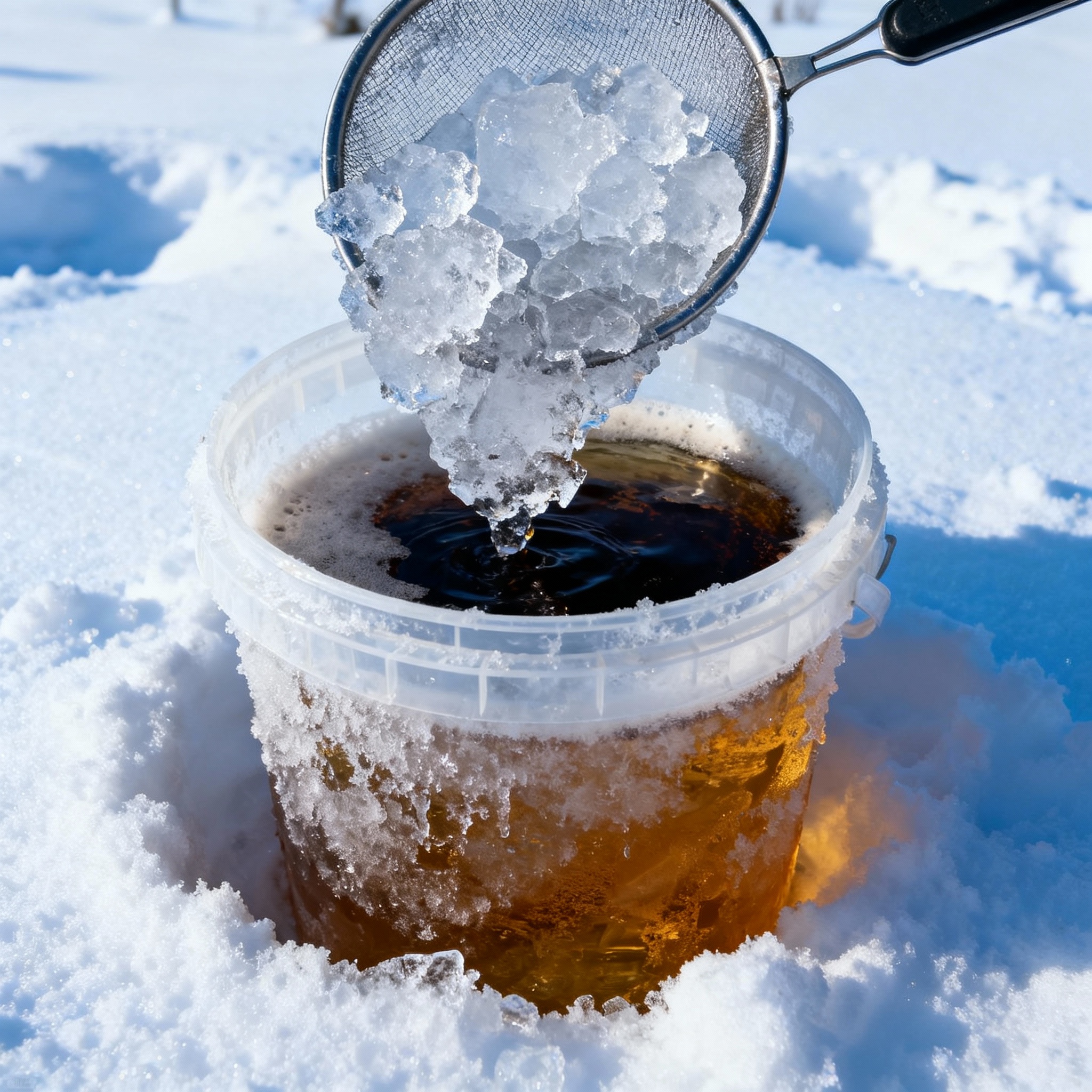
Then I learned how they made it. They took a strong doppelbock, froze it, and removed the ice.
What stayed behind was concentrated flavor, concentrated alcohol, and concentrated history. No boiling, no stills, just patience and cold.
I had to try it. That first attempt taught me two things: freeze distillation works better than it has any right to, and it also concentrates every single mistake you made during the original brew.
If your doppelbock had a slight fusel edge, your eisbock will taste like furniture polish. If your fermentation was clean, you’ll make something that belongs in a snifter, not a pint glass.
This isn’t a casual weekend project. Eisbock demands a nearly perfect base beer, careful monitoring, and an understanding that you’re walking a legal and chemical tightrope.
But if you do it right, you’ll produce something that commercial breweries charge $15 for a 12-ounce bottle. Let’s break down exactly how this works.
The Physics: Water Freezes Before Alcohol
The entire concept of eisbock relies on one simple fact: ethanol (drinking alcohol) freezes at minus 173 degrees Fahrenheit, while water freezes at 32 degrees Fahrenheit. That gap is enormous.
When you take a 7% doppelbock and drop it to 27 degrees Fahrenheit, the water starts forming ice crystals. The alcohol, along with dissolved sugars, proteins, and flavor compounds, stays liquid.
Remove the ice, and what’s left behind is more alcoholic and more flavorful. This isn’t distillation in the legal sense because you’re not boiling anything or using a still.
You’re doing fractional freezing. Some people call it freeze concentration, others call it jacking (as in applejack, which we’ll get to).
Technically, you’re not breaking any laws in the U.S. as a homebrewer because the TTB (Alcohol and Tobacco Tax and Trade Bureau) defines distillation as using heat. Freeze concentration occupies a gray area.
I’m not a lawyer, and I can’t tell you this is risk-free, but homebrewers have been doing this quietly for decades without enforcement action. The chemistry gets interesting when you start calculating concentration factors.
If you freeze out half the water from a 7% ABV doppelbock, you’re left with roughly 14% ABV. Freeze out two-thirds of the water, and you hit 21% ABV. That’s port wine territory.
But here’s the catch: you’re also concentrating everything else. Malt sweetness doubles. Hop bitterness doubles.
Fusel alcohols (the stuff that causes headaches) double. Diacetyl, if you had any, doubles. This is why your base beer must be nearly flawless.
I use a refractometer to estimate my final alcohol after freeze concentration, but it’s not perfectly accurate because the sugar content throws off the reading. A more reliable method is to weigh a known volume before and after.
Alcohol is lighter than water (specific gravity of 0.789 versus 1.0), so if your liquid gets lighter per ounce, you’ve concentrated the alcohol. I usually aim for a 1.5x to 2x concentration.
Going beyond that starts tasting more like a science experiment than a beverage.
Measure your starting volume carefully before freezing. You’ll use this to calculate how much water you’ve removed and estimate your final ABV. I mark the side of my fermenting bucket with a permanent marker so I know exactly where I started.
The Process: Freezing and Racking
You need a strong, clean base beer to start. I’m talking about a doppelbock in the 7% to 9% range with a final gravity around 1.020 to 1.024.
It should taste rich, malty, and slightly sweet with no off-flavors. Ferment it with a good lager yeast like WLP833 or Saflager W-34/70, and give it a proper diacetyl rest.
Let it lager for at least four weeks. If you rush this part, your eisbock will taste like warm pennies and nail polish remover.
Once your doppelbock is finished, you need to freeze it. I’ve done this two ways: in a chest freezer with a temperature controller, and outside during a North Carolina cold snap.
The chest freezer method is more reliable. Set your controller to 27 degrees Fahrenheit.
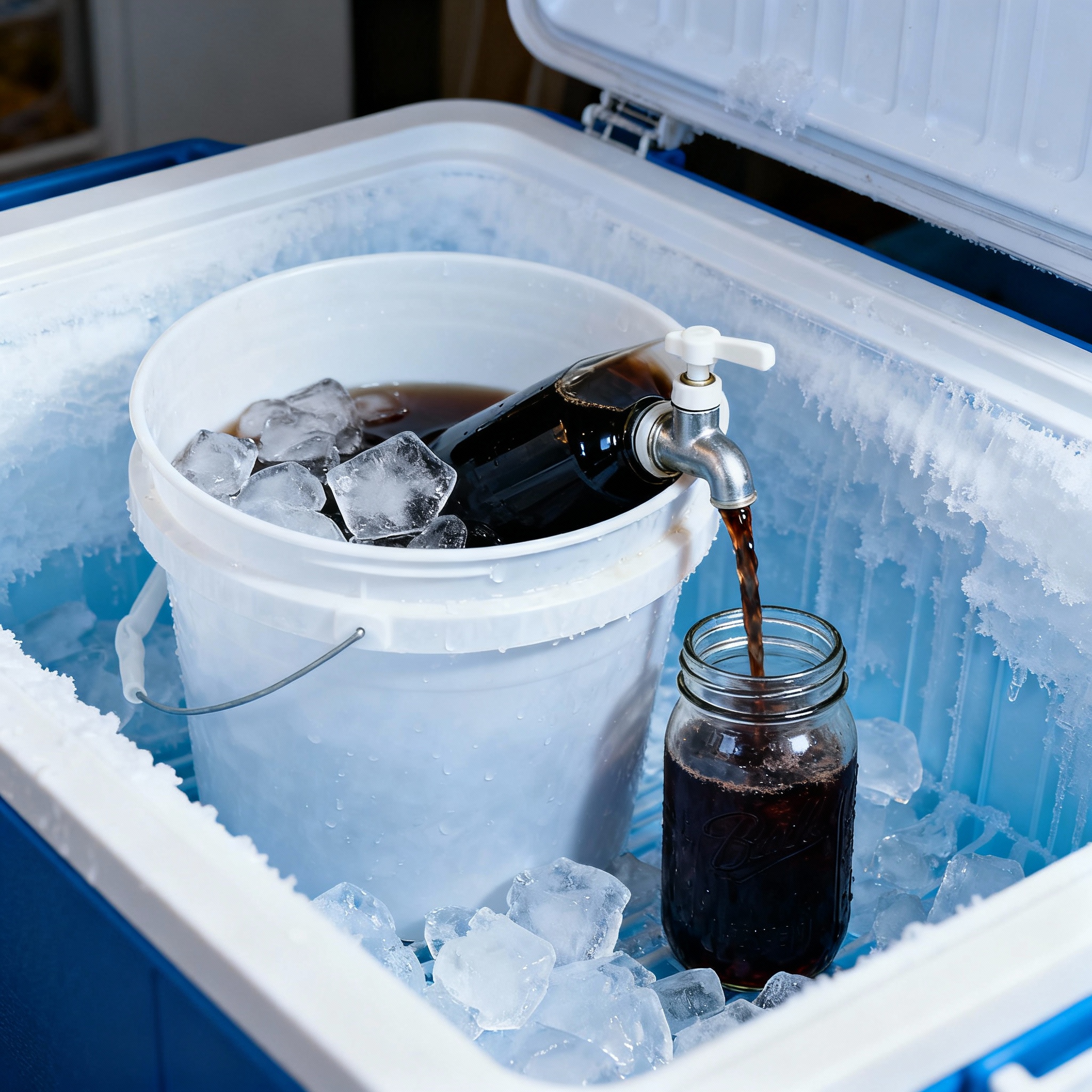
You want the beer to partially freeze, not turn into a solid block. I use a 5-gallon plastic fermenting bucket because it’s flexible and won’t crack under pressure as the ice expands.
After 24 to 48 hours, you’ll see ice forming on the surface and sides. It looks like a slushy or a snow cone mixture.
The goal is to get about 40% to 60% ice formation. Too little ice and you haven’t concentrated much.
Too much ice and you’ll struggle to separate the liquid. I check every 12 hours by gently tilting the bucket.
If I hear liquid sloshing under a layer of ice, I know I’m in the right range. Now comes the tricky part: separating the concentrated beer from the ice.
I drill a small hole near the bottom of the bucket (before freezing, obviously) and attach a spigot. When the beer is partially frozen, I open the spigot and let the liquid drain into a sanitized carboy.
The ice stays behind in the bucket. Some people use a mesh bag to strain out ice chunks, but I find the spigot method cleaner and less prone to contamination.
You can also carefully pour off the liquid, but you’ll lose some to ice melt. What you collect will be darker, thicker, and smell intensely of malt and alcohol.
The first runnings are the most concentrated. The last runnings will be weaker as the ice melts.
I usually stop draining when the liquid starts tasting thin or watery. You’ll lose some beer to the ice, but that’s the cost of concentration.
From a 5-gallon batch of doppelbock, I typically recover about 2.5 to 3 gallons of eisbock.
Freeze in stages if you want extreme concentration. Freeze once, drain, then freeze the collected liquid again. This two-stage process can push you past 20% ABV, but be warned: the flavor becomes almost overwhelming.
The “Applejack” Warning: Alcohol Congeners
Here’s where things get serious. When you concentrate alcohol by freezing, you don’t just concentrate ethanol.
You concentrate every single alcohol congener, including fusel alcohols like isoamyl alcohol, isobutanol, and propanol. These are the compounds responsible for hangovers, headaches, and that “I regret everything” feeling the next morning.
In a normal beer, they exist in small amounts and your liver processes them without much complaint. In an eisbock, they can be 2x to 3x higher.
This is the same problem that plagued traditional applejack production in colonial America. Farmers would leave hard cider outside to freeze, then drink the concentrated liquid.
It got you drunk fast and cheap, but it also gave you a legendary hangover. The term “apple palsy” referred to the tremors and headaches people experienced after drinking too much freeze-concentrated cider.
Modern applejack is made by proper distillation, which allows producers to separate out the harsh fusel alcohols. You can’t do that with freeze concentration.
I’ve had eisbocks that felt like getting hit by a truck the next morning, even after just one glass. The key to minimizing this is starting with a clean fermentation.
Keep your fermentation temperature stable and on the lower end of your yeast’s range. Avoid temperature spikes, which cause yeast stress and fusel production.
Pitch enough yeast (I use a 2-liter starter for a 5-gallon batch). Give it plenty of time to clean up after itself during lagering.
Now, the legal side. In the United States, homebrewers are allowed to produce beer and wine for personal consumption without a license.
Distillation, however, requires a federal permit, even if you’re not selling it. The TTB has historically not classified freeze concentration as distillation because no heat is involved.
But, and this is a big but, there is no official written exemption. You’re operating in a legal gray zone.
I’ve never heard of anyone getting in trouble for freeze concentrating beer at home, but I can’t promise it’s risk-free. Some states have their own regulations that might be stricter.
Do your homework. Selling eisbock without a license is absolutely illegal.
Even giving away large quantities could raise questions. I keep my eisbock production small, personal, and quiet.
I share it with close friends who understand what it is, and I make sure they know to sip it, not chug it. This is a 14% to 18% ABV beverage. Treat it like whiskey, not like a lager.
Label your bottles clearly with the ABV and a warning. I use a label maker and write something like “Eisbock - 16% ABV - Sip Slowly.” It sounds paranoid, but I’ve had friends assume it was regular beer and pour themselves a pint. (Use a hydrometer to check initial and final gravity).
Flavor Impact: Doubling the Malt, Alcohol, and Sweetness
When you remove half the water from a doppelbock, you don’t just get a stronger beer. You get a fundamentally different drink.
The malt sweetness becomes almost dessert-like. The alcohol warmth transitions from a gentle heat to a full burn.
The body goes from full to syrupy. And the bitterness, even if it was low to begin with, becomes more pronounced because your taste perception changes with higher alcohol levels.
I brewed a doppelbock base with a malt profile of Munich, Vienna, and a touch of Carafa for color. It had a smooth, toasty, bread-like flavor with hints of dark fruit.
After freeze concentration, those hints became the main event. The toastiness turned into caramel bordering on toffee.
The dark fruit became fig and raisin. The sweetness, which was pleasant before, became cloying if I drank more than four ounces at a time.
The alcohol itself changes character. In the base beer, the 8% ABV was warming but smooth.
In the eisbock at 16% ABV, it had a vinous quality, almost like a barleywine or a strong Scotch ale. Some people describe it as bourbon-like, though that’s a stretch.
It’s distinctly malty and beer-derived, not grain-neutral like vodka or woody like whiskey. But it does have that slow-building heat that coats your throat and chest.
Hop bitterness is tricky. Doppelbocks are not hoppy beers to begin with, usually sitting around 20 to 30 IBUs.
Use this calculator to determine how much your ABV has increased based on the volume of ice you’ve discarded from the fermenter.
🧊 Eisbock ABV & Concentration Calculator
After concentration, that becomes 40 to 60 IBUs in the same volume. But because your palate is also dealing with high alcohol and residual sweetness, the bitterness doesn’t taste twice as strong.
It tastes more integrated, almost herbal or spicy rather than bitter. I’ve found that eisbocks made from hop-forward beers (like IPAs) taste unbalanced and harsh. Stick with malt-forward styles.
Carbonation becomes almost irrelevant. Even if your base beer was well-carbonated, the freezing process knocks out most of the CO2.
What remains is a still or lightly carbonated liquid. I’ve tried force-carbonating eisbock after concentration, and it just tastes wrong.
The bubbles fight against the thick body and high sweetness. Traditional eisbocks are served still or with just a whisper of carbonation, like a cask ale.
I’ve come to prefer it that way.
Age your eisbock for at least three months after freeze concentration. The flavors need time to marry and the alcohol heat to mellow. After six months, the rough edges smooth out and the malt complexity deepens.
Carbonation: Why Eisbocks Are Usually Served Still
Carbonation and high-gravity freeze-concentrated beers don’t play well together. The physics work against you.
CO2 is less soluble in alcohol than in water, so your 16% ABV eisbock will hold less carbonation than a 5% pilsner even under the same pressure. On top of that, the freezing and thawing process drives out dissolved CO2.
By the time you’ve separated your liquid from the ice, most of the carbonation is gone. I learned this the hard way.
I bottled my first eisbock with priming sugar, expecting it to carbonate like a normal beer. Three weeks later, I opened a bottle and got a tiny hiss and almost no bubbles.
The yeast struggled in the high-alcohol environment, and even the small amount of CO2 they produced didn’t stay dissolved. I ended up with sweet, flat, boozy bottles that tasted unfinished.
The next batch, I tried force carbonating in a keg. I cranked the CO2 up to 20 PSI and let it sit for a week.
When I poured a glass, it had a brief, aggressive fizz that dissipated in seconds, leaving a still liquid with a thin film of foam. It didn’t taste bad, but it didn’t taste right either.
The carbonation felt forced, like it didn’t belong. After talking to other brewers and reading old German brewing texts, I realized that traditional eisbock is meant to be served still or nearly still.
This makes sense when you think about serving temperature and context. Eisbock is a sipper, not a session beer.
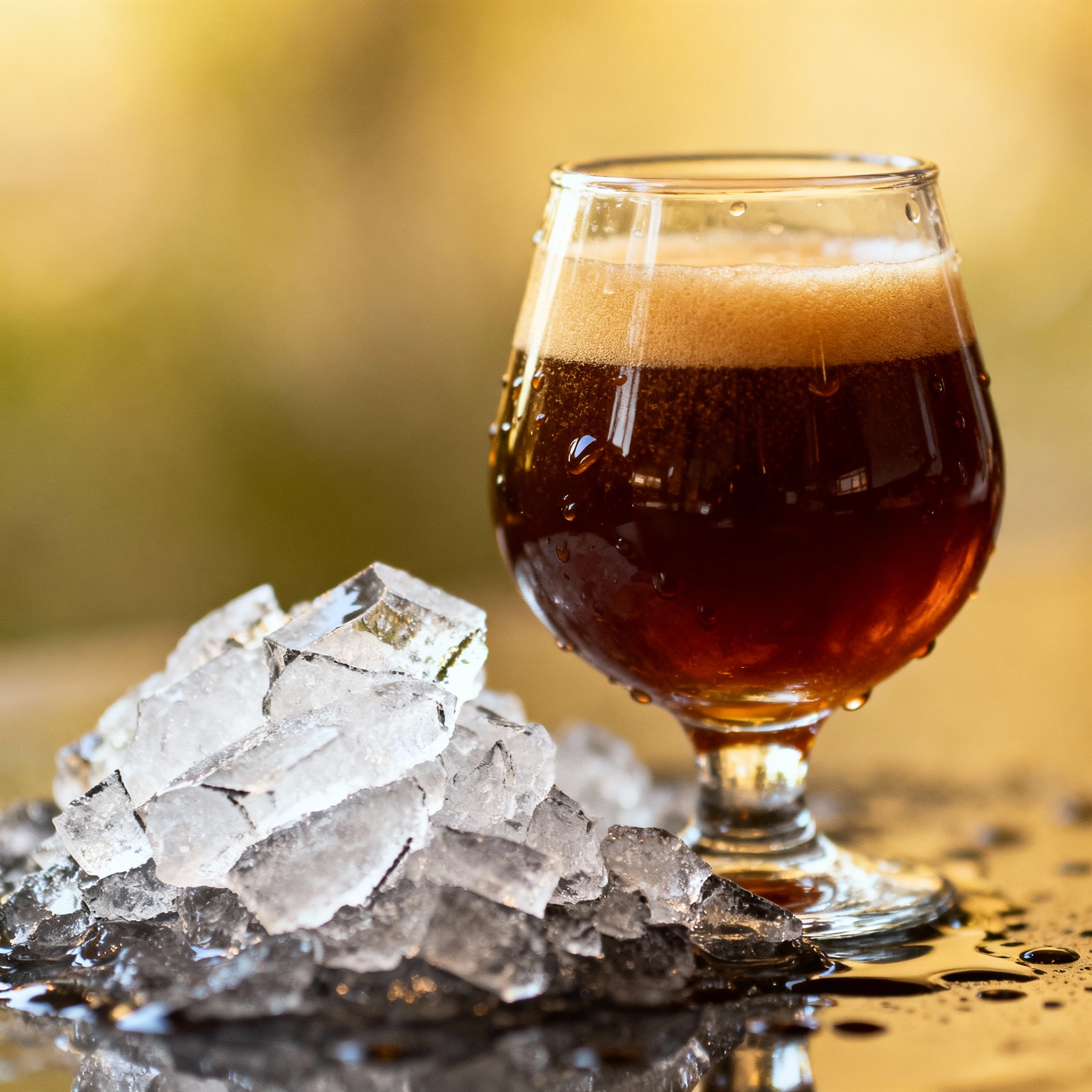
You pour two to four ounces into a snifter or tulip glass and let it warm slightly in your hand. The malt complexity opens up as it warms, and the alcohol vapors become aromatic rather than harsh.
Carbonation would just get in the way, making you feel full and bloated before you finish a small pour. It would also emphasize the alcohol burn rather than the malt sweetness.
I now bottle my eisbock completely still. I cold-crash the carboy after freeze concentration to drop out any remaining yeast and particulates, then bottle directly without priming sugar.
I use oxygen-absorbing caps to prevent oxidation, which is a bigger risk with still beer. The result is a smooth, almost liqueur-like drink that feels luxurious rather than beer-like.
If you absolutely must have some carbonation, aim for light carbonation at about 1.5 volumes of CO2, like an English bitter. Anything more is overkill.
Serve eisbock slightly chilled, not ice cold. I pull mine out of the fridge about 20 minutes before serving so it warms to around 50 to 55 degrees Fahrenheit. This is the sweet spot where the malt flavors shine.
Conclusion
Freeze distillation is one of those techniques that feels like a cheat code. You take a beer, remove some water, and suddenly you have something that tastes like it required twice the grain, twice the time, and twice the skill.
But the truth is more complicated. Eisbock demands a near-perfect base beer because every flaw gets magnified.
It concentrates fusel alcohols along with flavor, so you’d better ferment clean or prepare for a rough morning. It occupies a legal gray area that most authorities ignore, but that doesn’t mean it’s risk-free.
And the final product isn’t really beer anymore. It’s something in between beer and liqueur, something that belongs in a snifter next to a fireplace, not in a pint glass at a barbecue.
I make one or two batches a year, usually in late winter when my chest freezer isn’t full of fermenting lagers. I give most of it away in small bottles with hand-written labels that say “Handle with Care.”
People who try it are either fascinated or confused. Nobody is indifferent.
That’s the magic of eisbock. It forces you to slow down, to sip, to pay attention.
In a world of hazy IPAs and fruited sours designed to be chugged from a can, there’s something deeply satisfying about a beer that punches you in the face if you don’t respect it. If you’re going to try this, start with a doppelbock you’re proud of.
Ferment it cold and clean. Lager it for a month.
Then freeze it gently, separate carefully, and age patiently. The result is a beer that has been refined by frost into the ultimate expression of the brewer’s art.
References
- Daniels, R. (1996). Designing Great Beers. Brewers Publications.
- Palmer, J., & Kaminski, C. (2013). Water: A Comprehensive Guide. Brewers Publications.
- White Labs. WLP833 German Bock Lager Yeast Strain Profile.
- Schneider-Weisse. Aventinus Eisbock History and Production Notes.
- TTB. Homebrewing and Distillation Regulations.