The Packaging Dilemma: Bottling vs. Kegging.
Introduction: The Bottleneck (Literally) of Homebrewing
I have spent more Saturday afternoons than I care to admit sitting at my kitchen counter with a siphon tube in one hand and a beer bottle in the other.
Watching liquid slowly drip into 50 individual bottles is a test of patience.
By bottle 30, my back hurts, and by bottle 40, I start questioning my life choices.
By bottle 50, I am ready to throw the whole batch away and just buy beer from the store like a normal person.
Bottling is the point where homebrewing stops being fun and starts feeling like factory work.
You have already spent weeks waiting for fermentation to finish and have already sanitized everything twice.
You have already tasted the flat beer and know it is good.
And now you have to spend three hours hunched over a bottling bucket, priming each bottle, capping it, and praying you did not introduce oxygen.
This is the packaging dilemma that every homebrewer hits eventually.
The question is not whether kegging is better, but whether you can justify the cost, the space, and the permanent commitment.
This article is going to break down both systems honestly, including the hidden costs that nobody talks about until you are already halfway into the upgrade.
Section 1: The Case for Bottling
Bottling gets a bad reputation, but it is still the most practical option for a lot of brewers.
If you only brew once a month or you like to age beer for six months before drinking it, bottles are the right tool.
They are portable, allowing you to bring a six-pack to a party without lugging a keg and a picnic tap.
You can cellar a barleywine for two years in the back of a closet without worrying about keg seals drying out.
The startup cost is almost zero, as you probably already have bottles if you drink commercial beer.
A capper costs around 20 dollars, and a bag of caps or priming sugar costs only a few cents per batch.
Bottles are also better for certain styles, such as big stouts, sours, and barrel-aged beers.
The small amount of oxygen that sneaks in can actually help develop complex flavors in dark, malt-forward styles.
I have had homebrewed imperial stouts that tasted boozy at bottling but turned smooth after six months in the bottle.
The downside is that bottling is slow and inconsistent.
You have to measure priming sugar carefully, as too little makes the beer flat and too much creates “bottle bombs”.
Carbonation takes two weeks at room temperature, which means you cannot taste the final product right away.
Oxidation is the other hidden enemy.
Every time you transfer beer to the bottling bucket, you expose it to air.
This is fine for dark beers, but it kills the hop character in IPAs, often turning them into cardboard-flavored disappointments.
If you are bottling hoppy beers, add a crushed Campden tablet (sodium metabisulfite) to the bottling bucket. It scavenges oxygen and extends the shelf life.
- priming sugar: Standard carbonation requires approximately 4 to 6 grams of cane sugar per liter to reach 2.5 volumes of CO2.
- Temperature Variance: The amount of residual CO2 already in the beer depends on the highest temperature reached during fermentation.
- Consistency: Bulk priming in a dedicated bottling bucket is more reliable than adding individual sugar drops to each bottle.
Section 2: The Case for Kegging
Kegging is faster, cleaner, and gives you more control.
Instead of filling 50 bottles, you fill one keg.
Instead of waiting two weeks, you force-carbonate with CO2 and the beer is ready in 24 hours.
The biggest advantage is the closed transfer.
If you ferment in a keg or use a pressure transfer setup, the beer never touches air.
This is critical for hoppy beers, which can stay bright and fresh for six weeks in a keg.
The downside is cost and space.
A basic keg setup costs around 200 dollars, while a full kegerator with a tower tap can run 400 to 600 dollars.
You also need a dedicated fridge or freezer to keep the keg cold.
Kegs are also heavy and awkward to move, weighing about 55 pounds when full.
If you are buying your first keg, get a ball-lock style corny keg.
Section 3: The Hidden Costs of Kegging
The sticker price of a keg setup is misleading because it does not include ongoing costs.
CO2 tanks need to be refilled, and a five-pound tank will carbonate about 10 to 15 kegs.
If you brew twice a month, you are refilling the tank every six months.
Fridge space is the other hidden cost.
A standard fridge fits one or two kegs, so multiple taps usually require a dedicated chest freezer conversion.
Keg maintenance also adds up, requiring replacement O-rings, keg lube, and line cleaner.
If you let a keg sit empty, the seals dry out and cause slow leaks.
The other cost is time investment.
You have to learn to set carbonation pressure, clean draft lines, and troubleshoot leaks.
It took me three batches before I stopped over-carbonating everything and creating beer foam spray.
- Pressure/Temperature Relationship: The solubility of CO2 in beer is inversely proportional to temperature and directly proportional to pressure.
- Volume Targets: For a standard ale at 38°F, maintaining 10-12 PSI will result in approximately 2.5 volumes of CO2.
- Equilibrium: Force carbonation requires the liquid to reach a state of equilibrium with the head space pressure over several days.
Buy a CO2 tank with a built-in shutoff valve and keep it turned off when you are not actively carbonating. This prevents slow leaks from draining the tank overnight.
Section 4: The Hybrid Approach (Bottling from the Keg)
You do not have to choose one system forever.
I use a hybrid approach where I keg most of my beer but bottle a few for storage or sharing.
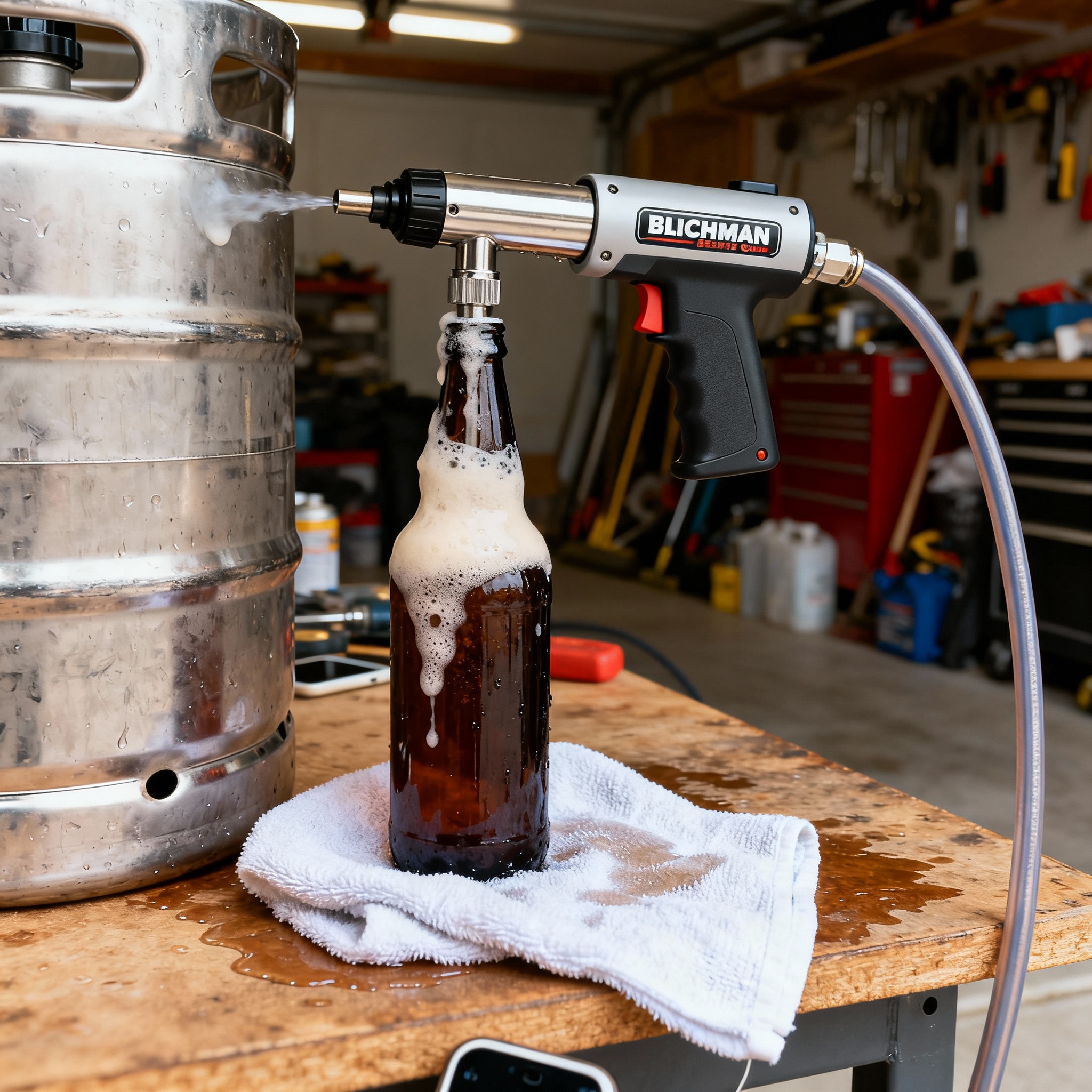
The tool that makes this work is a counter-pressure bottle filler like the BeerGun.
The BeerGun lets you fill bottles directly from the keg without losing carbonation.
You purge the bottle with CO2 and fill it slowly from the bottom up to avoid oxidation.
This gives you the best of both worlds: the speed of kegging with the portability of bottling.
The downside is that counter-pressure fillers are finicky.
You have to dial in the right CO2 pressure to avoid foaming.
It takes practice, but once you get the technique down, it is a huge time-saver.
Section 5: Maintenance (Washing 50 Bottles vs. Cleaning 1 Keg)
The worst part of bottling is washing 50 bottles before you can start.
You have to rinse each bottle, soak them in sanitizer, and let them dry.
Even with a good system, washing and sanitizing 50 bottles takes at least an hour.
If you reuse commercial bottles, you also have to deal with peeling off labels.
Kegging is simpler but not zero maintenance.
the line and then soak with a caustic cleaner for 20 minutes.
The whole process takes about 30 minutes per keg.
You also have to clean the dip tube and keg posts every few batches.
Draft lines also require cleaning every few kegs to prevent yeast and protein buildup.
It is a necessary step to ensure the flavor of the beer is not affected.
The per-batch effort is lower with kegging, even if the learning curve is steeper.
Mark your kegs with a piece of tape and a Sharpie to track what is inside. I also write down the carbonation pressure and the date I filled it.
Conclusion
The honest answer is that bottling is better for some brewers and kegging is better for others.
If you brew occasionally, age beer, or are on a budget, bottling gets the job done.
If you brew regularly and want better control over carbonation and freshness, kegging is worth the investment.
I spent five years bottling everything before I finally bought a keg setup, and I wish I had done it sooner.
The upfront cost was high, but the time saved and the improvement in hop freshness made the math make sense.
Kegging did not make me a better brewer, but it made brewing less exhausting.
The goal is to remove the friction that keeps you from brewing more often.
Start with bottling and upgrade to kegging when bottling day becomes the part of brewing you dread the most.
You do not have to switch completely; use the hybrid approach to get the best results for every style you brew.
Cost Comparison Table
| Item | Bottling (Startup) | Kegging (Startup) |
|---|---|---|
| Bottles (reused) | $0 | N/A |
| Capper | $20 | N/A |
| Caps (per batch) | $3 | N/A |
| Priming sugar (per batch) | $1 | N/A |
| Corny keg (used) | N/A | 60 |
| CO2 tank (5 lb) | N/A | 80 |
| Regulator | N/A | 60 |
| Picnic tap | N/A | 15 |
| Kegerator/freezer | N/A | 600 |
| Total (first batch) | ~$24 | ~800 |
| Per-batch cost | ~$4 | ~$2 (CO2 refills) |
References
- Palmer, J. (2017). How to Brew: Everything You Need to Know to Brew Great Beer Every Time. Brewers Publications.
- Mosher, R. (2021). Mastering Homebrew: The Complete Guide to Brewing Delicious Beer. Chronicle Books.
- Homebrew Talk forums. Community discussions on bottling vs. kegging trade-offs.
- American Homebrewers Association. Kegging guide and maintenance.