Mead Styles: Melomels, Metheglins, and Bochets.
I was four meads deep into my first year of fermentation when I realized I had no idea what to call anything I was making. One batch had blackberries.
Another had cinnamon sticks floating in it like driftwood. A third one tasted like burnt marshmallows because I got distracted watching a show and scorched the honey. I posted photos online and someone commented, “Nice bochet, did you dilute before adding the water?” I had to Google what a bochet even was.
Mead has more names than any other fermented drink I know. Wine people argue about terroir. Beer people argue about hops. Mead people argue about taxonomy.
And honestly, the naming conventions are a mess because they come from different traditions (Polish, Ethiopian, medieval English) that never agreed on anything. But once you understand the categories, you unlock a whole toolkit. You stop making “honey wine with stuff in it” and start designing flavor profiles like you actually know what you’re doing.
This guide is not for beginners who just want to dump honey in water and add yeast. This is for people who have made at least one mead, realized it tasted like alcoholic cough syrup, and want to know why the pros talk about melomels and metheglins like they’re different species.
Melomels: Fruit Meads and the Primary vs. Secondary Debate
A melomel is mead with fruit. That’s it. The word comes from the Greek “meli” (honey) and “melon” (apple), but it now covers any fruit addition. I know its a lot of useless info but its just my ADHD kicking into my writing.
If you add raspberries, it’s a melomel. If you add mango, it’s a melomel. If you add durian (which I have not tried but would absolutely document), it’s still a melomel.
The real question is not what fruit you use. The real question is when you add it.
Adding fruit in primary fermentation means the yeast eats the fruit sugars along with the honey sugars. You get a drier mead with integrated fruit character.
The downside is that fermentation strips out the volatile aromatics. Your strawberry melomel might taste like strawberry but it will not smell like fresh strawberries. The yeast cuts that out. I learned this the hard way with a peach melomel that had no smell and tasted something like canned peaches.
Adding fruit in secondary (after primary fermentation is done) preserves the fresh fruit aroma. The alcohol extracts flavor compounds without the yeast chewing through the delicate esters.
This method works great for berries, stone fruit, and anything with a strong aromatic profile. The downside is that you introduce new sugars, which can restart fermentation. If you bottle too early, you get bottle bombs. I have cleaned mead off a ceiling. It is not fun.
There is a third method that nobody talks about enough: adding fruit in stages. You add half the fruit in primary for fermentation character, then add the second half in secondary for aroma. This is what I do now for anything with expensive fruit. You get depth and freshness in the same glass.
One thing I track obsessively is the weight ratio of fruit to honey. Most recipes say “add two pounds of berries per gallon,” but that tells you nothing about the actual sugar contribution. I weigh the fruit, estimate the sugar content (raspberries are about 4% sugar, cherries are closer to 12%), and calculate how much that will raise the gravity. If I am aiming for a 12% ABV melomel and I add high-sugar fruit, I reduce the honey accordingly. Otherwise, I end up with a 15% rocket fuel mead that nobody wants to drink.
Freeze your fruit before adding it to the fermenter. Freezing ruptures the cell walls and releases more juice. You get better extraction without having to macerate or blend, which introduces oxygen. I keep a chest freezer in the garage just for this.
Metheglins: Spiced Meads and the Tincture Method
A metheglin is mead with spices or herbs. The word probably comes from the Welsh “meddyglyn,” meaning medicinal liquor, which makes sense because medieval metheglins were basically herbal medicine disguised as alcohol. People would steep everything from hyssop to wormwood in honey wine and claim it cured gout or bad humors or whatever.
Modern metheglins are less about medicine and more about layering flavors. The problem is that most people just throw whole spices into the fermenter and hope for the best.
I did this with my first metheglin. I added six cinnamon sticks, a handful of cloves, and a piece of ginger root. It tasted like someone dissolved a candle in mead. The spices were harsh, medicinal, and completely unbalanced.
The better method is tinctures. You take your spices (vanilla beans, cinnamon, ginger, cardamom, whatever), break them up, and soak them in high-proof neutral alcohol (I use Everclear or cheap vodka). Let them sit for a week or two. You now have a concentrated flavor extract that you can dose into the finished mead in controlled amounts.
Here is how I do it. I make a one-ounce tincture of each spice I want to use. Then I pull a 100ml sample of the finished mead and add the tincture one drop at a time. I taste after every five drops. When I hit the flavor I want, I scale up the math.
If I used 10 drops in 100ml, I need 100 drops (roughly 5ml) per liter. For a five-gallon batch, that is about 25ml of tincture. This method gives you precision. You do not overshoot. You do not waste a batch because you added too much clove.
Vanilla is the easiest tincture to start with. Take two vanilla beans, split them, scrape the seeds, and drop the whole mess into four ounces of vodka. Wait two weeks. You now have vanilla extract that costs you about three dollars instead of twelve dollars at the store. Add it to a traditional mead and you get a smooth, almost creamy finish. I use this in almost every mead I make now because it rounds out the sharp alcohol notes from young batches.
Ginger is harder. Fresh ginger tinctures taste grassy and vegetal. Dried ginger tinctures taste dusty. I have had better luck with crystallized ginger (the candied kind).
It is already sweetened, but the tincture pulls out a clean ginger flavor without the harshness. I use it in session meads where I want a spicy bite without adding heat.
Cinnamon tinctures are dangerous. A little goes a long way. Five drops too many and your mead tastes like Big Red gum. I learned this by ruining a three-gallon batch of apple cyser. Now I dose cinnamon at half the rate of other spices and I always start low.
Label your tinctures with the date and the source. I have four unmarked jars in my lab right now and I have no idea which one is star anise and which one is fennel. Do not be like me.
Bochets: Burnt Honey Mead and the Honey Napalm Problem
A bochet is mead made with caramelized honey. You heat the honey until it darkens and develops caramel, toffee, and marshmallow notes. It is one of the oldest mead styles and also one of the most dangerous to make.
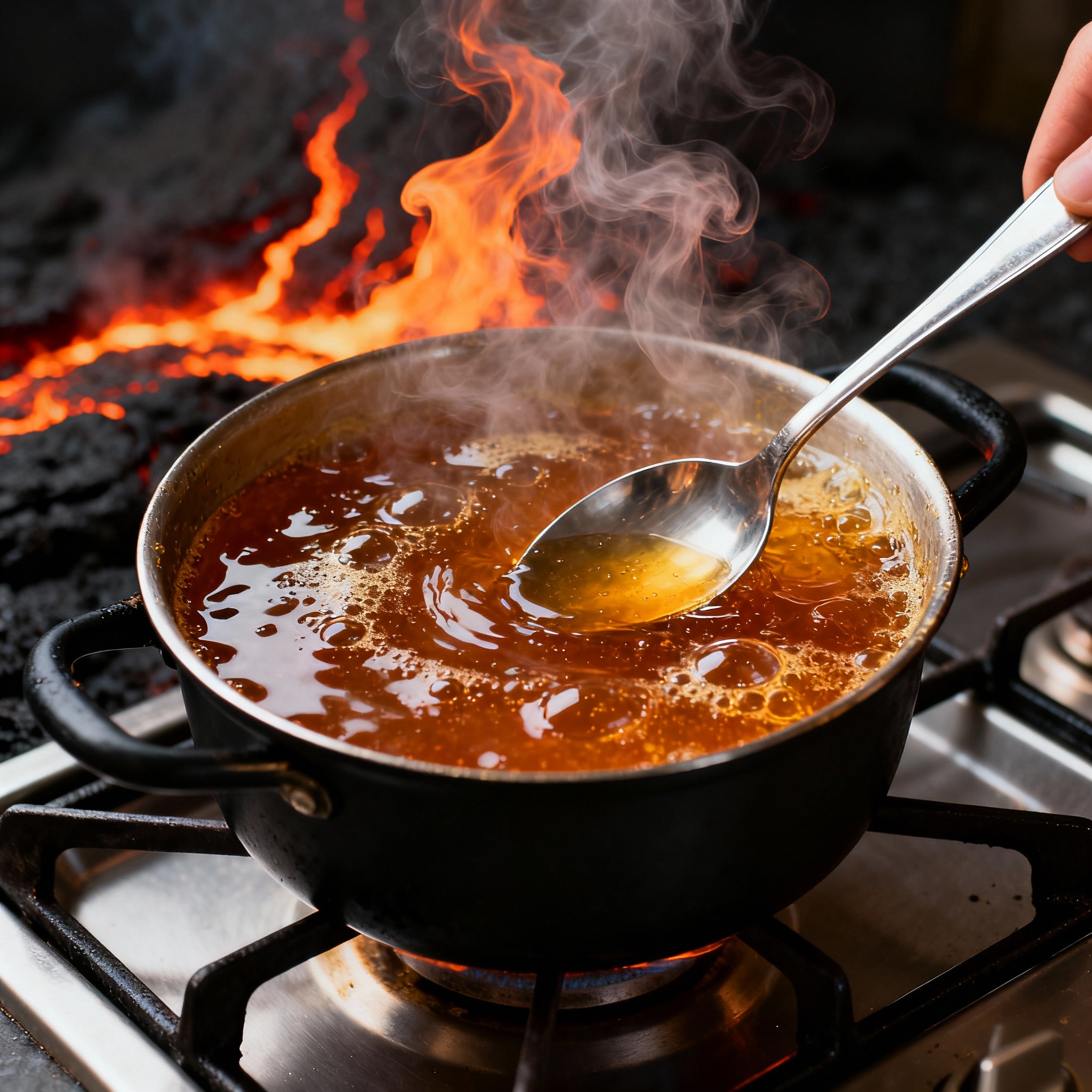
The first time I made a bochet, I poured three pounds of honey into a heavy saucepan and cranked the heat to medium-high. The honey bubbled. It smelled amazing. Then it started smoking. Then it turned black. Then it caught fire. I grabbed the pan, ran outside, and dumped it in the snow. My wife asked what I was doing and I said, “Science.” She did not believe me.
Honey caramelizes at a lower temperature than sugar because it contains fructose, which breaks down faster than sucrose. But honey also contains water, and when you heat honey, the water boils off and the sugars concentrate. If you heat it too fast, the sugars burn before they caramelize. You get acrid, bitter flavors instead of the smooth toffee notes you want.
The safe method is low and slow. Use a heavy pot (stainless steel or enameled cast iron). Heat the honey over medium-low. Stir constantly. You are looking for a color change from pale gold to amber to dark brown.
The darker you go, the more intense the flavor, but also the more risk of burning. I stop when the honey reaches the color of dark maple syrup. That gives me toasted marshmallow and caramel without crossing into burnt territory.
The other danger is what I call honey napalm. Caramelized honey is sticky, superheated, and hydrophobic. If you add water to hot honey, it does not mix. It splatters. I once added cold water to a pot of 300-degree honey and it erupted like a volcano.
I had burns on my forearm for a week. Now I let the honey cool to at least 200 degrees Fahrenheit before I add anything. Even then, I add the water slowly, stirring constantly, wearing long sleeves and safety glasses.
Once you have caramelized honey, the actual mead-making process is the same as a traditional mead. You dilute the honey to your target gravity, add yeast, and ferment. The caramelized sugars add complexity but they do not ferment any differently than raw honey.
What you do get is a mead with layers. The front is sweet and floral (from the uncaramelized sugars that remain). The mid-palate is toffee and burnt sugar. The finish is almost smoky, like a scotch whisky.
I blend bochets with traditional meads to add depth. A 50-50 blend of bochet and plain mead gives you complexity without overwhelming the palate. I also use small amounts of bochet as a sweetener in session meads. It adds flavor and body without adding as much fermentable sugar.
Use a candy thermometer. I clip mine to the side of the pot and watch the temperature like a hawk. When the honey hits 240 degrees Fahrenheit, it is in the danger zone. Pull it off the heat, let it coast to your target color, then cool it down. Do not walk away. Do not check your phone. Do not trust yourself.
Cysers and Pyments: Blending Honey with Juice
A cyser is mead made with apple juice instead of water. A pyment is mead made with grape juice. Both are technically melomels (because fruit), but they get their own names because the juice replaces the water entirely. You are not adding fruit to mead. You are making mead out of fruit.
I started making cysers because I had access to cheap fresh-pressed apple juice from a local orchard. They sell it in gallon jugs for five dollars, unpasteurized, no preservatives. I took three gallons of juice, added two pounds of honey, pitched a wine yeast, and forgot about it for three months.
When I opened the carboy, it smelled like dry champagne with apple blossoms. It was the easiest good mead I have ever made.
The key to cysers is balancing the apple character with the honey. Too much honey and it tastes like mead with a hint of apple. Too little honey and it tastes like hard cider. I aim for a 60-40 ratio of juice to honey by volume. That gives me enough honey to call it mead but enough apple to make it interesting.
Pyments are harder because grape juice (or wine must) has tannins. Tannins add structure, but they also add bitterness if you are not careful. I made a pyment with Concord grape juice once and it tasted like alcoholic cough syrup because the tannins combined with the honey in a way that amplified the medicinal notes.
Now I use white grape juice or low-tannin reds like Merlot. I also add the honey after primary fermentation instead of at the start. The yeast ferments the grape sugars first, then I back-sweeten with honey. This keeps the honey aromatics intact.
One trick I learned from a winemaker in Asheville is to use frozen grape must instead of fresh juice. You can buy frozen must from winemaking suppliers in five-gallon buckets.
It is already crushed, sulfited, and ready to ferment. I add honey at a rate of one pound per gallon of must, ferment it dry, then stabilize and back-sweeten. The result is a pyment that tastes like dessert wine with a floral finish.
If you use fresh-pressed apple juice, let it settle for 24 hours in the fridge before you add yeast. The pectin and solids will drop out. Rack off the clear juice and ferment that. You will get a clearer mead with less haze. I learned this from a cider maker in Vermont who said he never filters anything because he lets gravity do the work.
Hydromels: Session Meads for Everyday Drinking
A hydromel is a low-alcohol mead, usually between 3% and 7% ABV. The name comes from “hydro” (water) and “mel” (honey), which tells you that it is a watered-down version of traditional mead. That sounds boring, but hydromels are secretly the most practical style you can make.
Traditional meads take months to age. A 14% ABV mead needs at least six mBottling also matters. I bottle in swing-top bottles because I can crack one open every month to check how it’s aging without committing to a whole batch. If it still tastes rough, I leave the rest alone. If it’s good, I know the rest of the batch is ready. in four to six weeks.
You can brew a batch, ferment it, keg it, carbonate it, and drink it in the time it takes a traditional mead to finish primary fermentation.
The challenge with hydromels is that they taste thin if you do not add body. Honey contributes sweetness and mouthfeel, but if you dilute it too much, you get something that tastes like sparkling water with a hint of honey. I fix this by adding unfermentable sugars (lactose or maltodextrin) or by back-sweetening with more honey after fermentation.
Here is my standard hydromel recipe. I start with a gravity of 1.040, which gives me about 5% ABV after fermentation. I use a clean ale yeast (US-05 or Nottingham) because wine yeasts strip out too much flavor at low alcohol levels.
I ferment at 65 degrees Fahrenheit for two weeks. Then I keg it, add potassium sorbate and potassium metabisulfite to stop fermentation, and back-sweeten with honey to 1.010. I carbonate it to about 2.5 volumes of CO2, which is slightly less than beer but more than cider.
The result is a sparkling mead that drinks like a session beer. It is light, refreshing, and you can have two glasses without feeling like you drank a bottle of wine. I make these in the summer and keep them on tap in the kegerator. They last about two weeks before the keg kicks, which tells me people actually like drinking them.
I also experiment with hopped hydromels. I add hops in secondary (dry hopping) to get the aroma without the bitterness. Citra and Mosaic hops pair well with honey because they have tropical fruit notes that complement the floral character.
I do not boil the hops. I just add them as pellets, let them sit for three days, then cold-crash and keg. The hops add complexity without making it taste like beer.
If you carbonate hydromels, use a spunding valve or a keg setup. Do not bottle carbonate. Honey is unpredictable and bottle bombs are real. I know someone who lost an entire batch because the bottles grenaded in his closet. He said it sounded like fireworks at 3 a.m. and his landlord was not happy.
Closing Thoughts
Mead styles are not rigid rules. They are a language for describing what you made. If you add blackberries, call it a melomel. If you add cinnamon, call it a metheglin. If you burn the honey and set off the smoke alarm, call it a bochet and pretend you meant to do that.
The naming conventions help you communicate with other mead makers, but they also help you think about flavor design. When I know I am making a cyser, I think about apple varieties and tannin balance. When I know I am making a bochet, I think about caramelization temperatures and maillard reactions. The categories give me a framework for making decisions instead of just winging it.
I still make batches that fail. I still have carboys in the garage that taste like mistakes. But now I can at least name the mistakes and figure out what went wrong. That is progress.