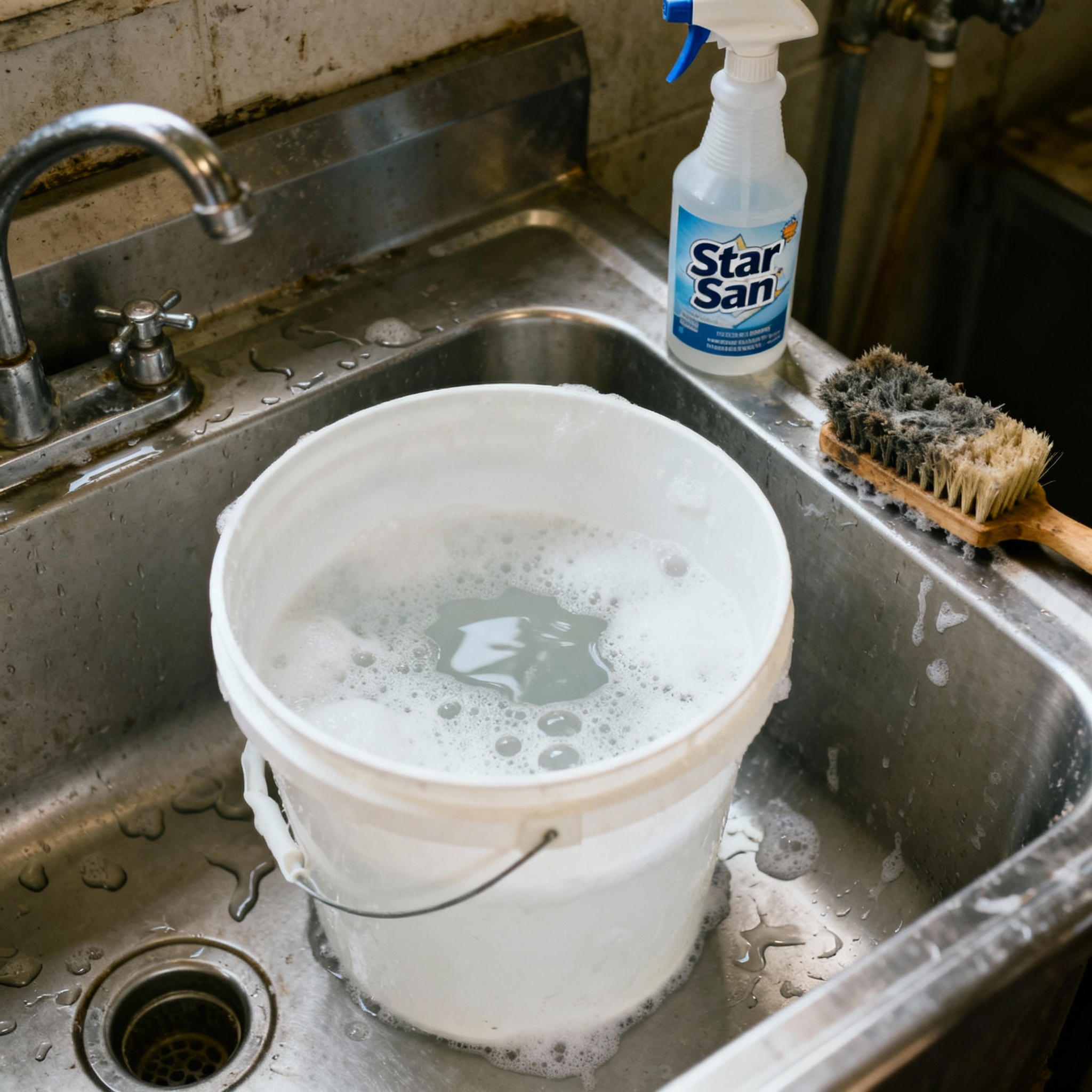
Chemical Warfare: A Complete Guide to Brewery Cleaning & Sanitation
I learned this the hard way after dumping three gallons of a cherry sour into the yard. The fermentation smelled like rotting gym socks instead of fruit, and I blamed everything except the real culprit.
I tested the pH, checked fermentation temps, and even bought a microscope to look for wild yeast. Turns out, I had missed a thin film of dried wort inside the racking cane from the previous batch.
That invisible residue harbored bacteria that wrecked six weeks of work. You can’t sanitize dirt; that sentence changed how I brew.
Cleaning is not the boring step you rush through to get to the fun part. It is the foundation.
If you skip it or do it halfway, you are not brewing beer anymore. You are rolling dice and hoping contamination doesn’t show up before bottling day.
Most beginner guides treat cleaning like an afterthought. They give you a two-sentence summary and move on to grain bills and hop schedules.
But professionals will tell you that 90% of brewing is cleaning. The mash does itself if you hit the right temp, and the yeast does its job if you pitch enough healthy cells.
The only variable you control from start to finish is whether your equipment is actually clean. That is what this guide is about.
I am not going to tell you to “rinse everything really well” and call it done. I am going to walk you through the chemistry, the products that actually work, and the methods I use in the garage lab.
The Cleaners: PBW vs. OxiClean
There are two types of soil in a brewery: organic soil (proteins, sugars, hop resins) and mineral soil (calcium deposits, beer stone). Alkali cleaners attack organic soil, while acid cleaners attack mineral soil.
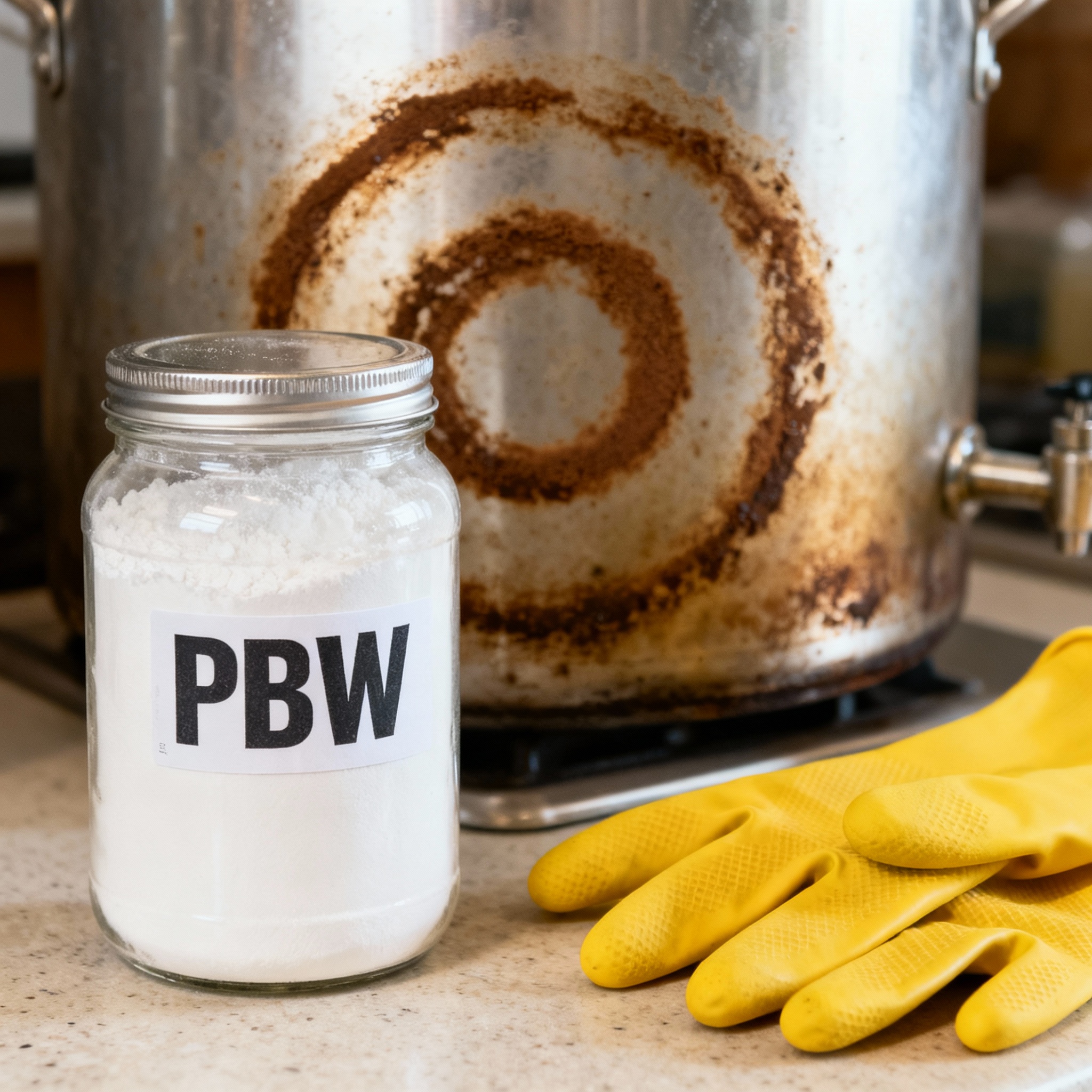
You need both, but most of the time you are dealing with organic soil, so you need a good alkali cleaner. PBW (Powdered Brewery Wash) is the industry standard.
It is a buffered alkali cleaner that uses oxygen and surfactants to break down proteins and organic material. It works in cold or warm water, though warm water speeds things up.
The reason breweries pay for PBW instead of using dish soap is because it rinses completely. No residue, no foam carryover, and no off-flavors.
OxiClean Free cleaner (the unscented version) is sodium percarbonate, which is also the active ingredient in PBW. The difference is PBW includes additional surfactants and buffers that make it more effective on protein-heavy soils.
OxiClean Free works well for general cleaning, especially for items that did not contact finished beer. I use it to clean bottles, growlers, and anything that just needs organic material scrubbed off.
Neither should sit on aluminum for more than an hour because alkali cleaners can corrode it. The method is the same for both: dissolve 1 to 2 tablespoons per gallon of warm water (120 to 140 degrees F), soak for 20 to 30 minutes, and rinse thoroughly.
If you are cleaning a carboy or fermenter, fill it halfway with hot PBW solution and shake it hard for 30 seconds. Let it sit for 10 minutes, then shake again to get into the shoulders where soil hides.
The Sanitizers: Star San vs. Iodine
Cleaning removes soil, while sanitizing reduces microbial load to safe levels. You cannot skip cleaning and go straight to sanitizing because sanitizers do not work in the presence of organic material.
Star San sanitizer is an acid anionic surfactant. It works by dropping the pH to around 3.0 and using dodecylbenzenesulfonic acid to disrupt cell walls.
It is effective against bacteria, wild yeast, and mold in 30 seconds of contact time. The key advantage is that it is a no-rinse sanitizer.
The yeast will neutralize the small amount of residual acid, and the concentration is far too low to affect flavor. I mix Star San at 1 oz per 5 gallons of water and keep a spray bottle ready.
The dodecylbenzenesulfonic acid (C18H30O3S) in Star San works by lowering the surface tension of the liquid, allowing it to penetrate microscopic cracks. At a pH below 3.5, the acid becomes lethal to microbes by disrupting the permeability of their cytoplasmic membranes.
Iodophor is the alternative. It is iodine-based and works by oxidizing cell components.
The main reason I switched to Star San is because Iodophor stains plastic over time and loses potency when exposed to light or heat. You cannot store a bucket of mixed Iodophor for weeks like you can with Star San.
Do not rinse Star San with tap water unless your municipal supply is chlorine-free. Chlorine and chloramine can harbor bacteria; if you must rinse, use boiled and cooled water or distilled water.
The Acid Cycle: Removing Beer Stone
Alkali cleaners like PBW do not touch mineral deposits. Over time, calcium oxalate (beer stone) builds up on the inside of kettles and fermenters.
It looks like a chalky white or tan crust. If you ignore it, the rough surface becomes a breeding ground for bacteria.
I run an acid cycle every five to ten batches using food-grade citric acid. I mix two tablespoons per gallon of warm water and soak the affected item for 30 to 60 minutes.
The acid dissolves the calcium oxalate, and the deposits wipe away with a sponge. You will know you need an acid cycle when you see mineral films that do not come off with PBW.
If you brew with very hard water (above 200 ppm calcium), add an acid cycle to your regular cleaning rotation. Preventing beer stone is easier than removing it.
Plastic Care: Buckets Without Scratches
Plastic fermenters are cheap and lightweight, but they are also the hardest to keep sanitary long-term. Every scratch, gouge, or crack is a hiding place for bacteria.
I learned this after a batch developed diacetyl off-flavors because bacteria were living in fine scratches from using a scrub pad. The first rule of plastic care is to never use abrasive scrubbers.
I use soft sponges or microfiber cloths only. If something is stuck, I soak it longer in PBW instead of scrubbing harder.
I hold my buckets up to a bright light and look for scratches or cloudiness. If the plastic looks hazy or feels rough, I replace it immediately.
If you drop a plastic fermenter and crack it even slightly, throw it away. Cracks cannot be sanitized, and it is not worth the risk of losing a full batch of ingredients.
Pump and Chiller Loops: CIP Techniques
If you use a pump or plate chiller, you are dealing with equipment you cannot see inside. These items need Clean In Place (CIP) techniques, circulating solutions through the system without disassembly.
I run a three-step CIP cycle after every brew day. First, I flush with hot water immediately after use while the equipment is still warm to prevent wort from drying.
Second, I circulate PBW solution in a closed loop for 15 to 20 minutes to break down protein or hop material. Third, I flush with hot water again and then circulate Star San solution.
For plate chillers, I reverse the flow halfway through each cycle to ensure I hit every channel. Plate chillers are notorious for trapping debris because of the narrow passages between plates.
If you do not have a CIP setup, you can use a drill-powered pump and a bucket to achieve the same result. The key is circulation and contact time, not expensive equipment.
Conclusion
The chemistry is simple: alkali cleaners remove organic soil, acid cleaners remove mineral deposits, and sanitizers reduce microbial load. If you skip a step, you are gambling with contamination.
I keep four products in the garage lab: PBW, OxiClean Free, citric acid, and Star San. That covers 99% of what I need.
The other 1% is vigilance. I inspect my gear, replace worn plastic, and I do not rush through cleaning just because I am tired after a six-hour brew day.
Buy less equipment and spend more time cleaning what you already have. A clean bucket beats a fancy conical fermenter full of bacteria every single time.
Cleaning Chemical Dilution Reference Table
| Chemical | Dilution Rate | Water Temp | Soak Time | Use Case |
|---|---|---|---|---|
| PBW | 1-2 tbsp/gal | 120-140 F | 20-30 min | Post-boil gear, kegs |
| OxiClean Free | 1-2 tbsp/gal | 120-140 F | 20-30 min | Bottles, pre-boil gear |
| Star San | 1 oz/5 gal | Cold | 30 sec | All clean surfaces |
| Iodophor | 1 tbsp/5 gal | Cold | 2 min | Alternative sanitizer |
| Citric Acid | 2 tbsp/gal | Warm-Hot | 30-60 min | Beer stone removal |
References
- Palmer, J., & Kaminski, C. Water: A Comprehensive Guide for Brewers. Brewers Publications, 2013.
- Five Star Chemicals. “PBW Technical Data Sheet.”
- White, C., & Zainasheff, J. Yeast: The Practical Guide to Beer Fermentation. 2010.
- UC Davis Extension. “Sanitation in Food Processing.”