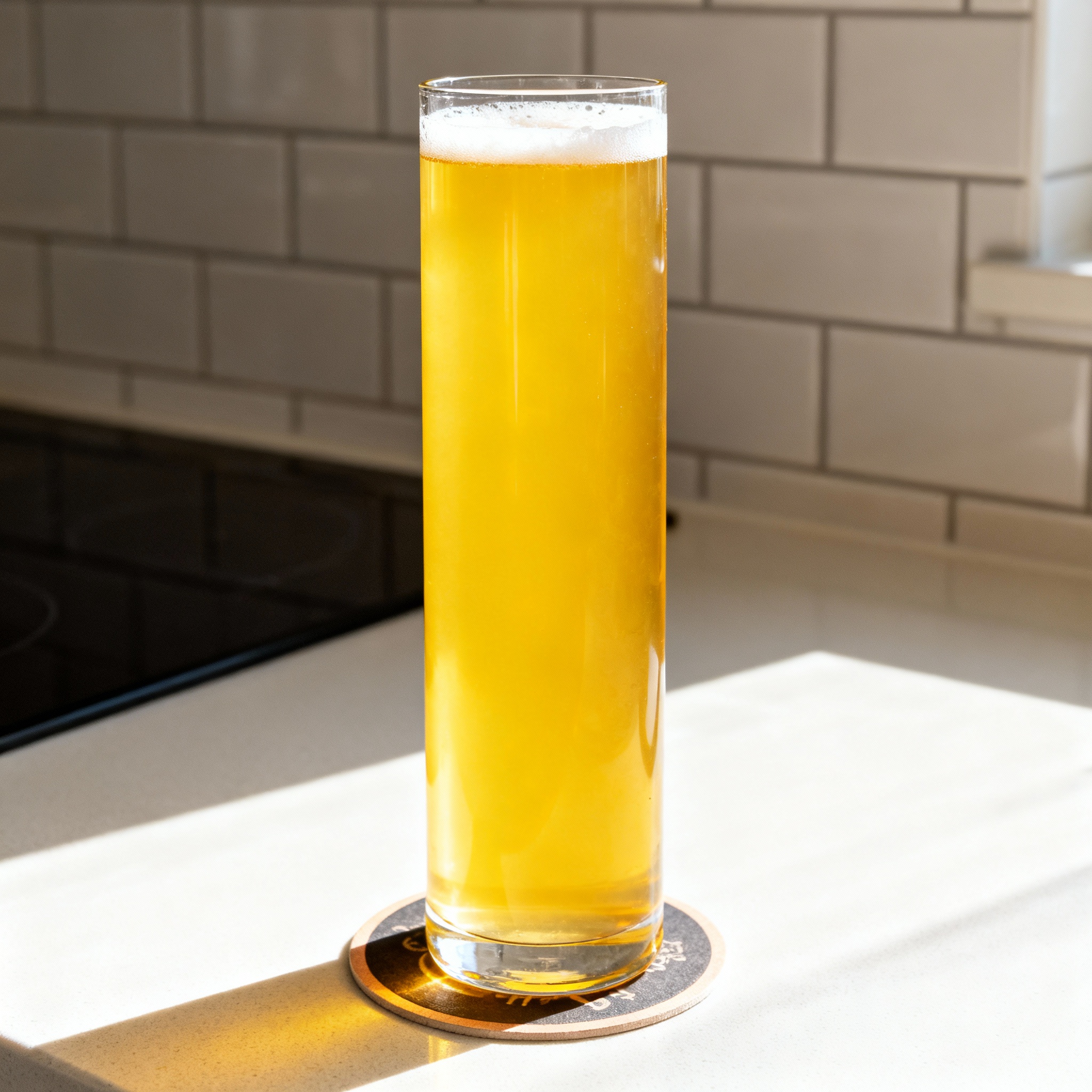
Kölsch: The Rule-Abiding Hybrid
I don’t care how good your version tastes. If you didn’t brew it in Cologne, you can’t technically call it Kölsch.
The Kölsch Konvention, signed in 1986, is an appellation system that makes French wine regions look relaxed. Only 24 breweries in Köln (Cologne) can use the name; everyone else is making “Kölsch-style ale.”
This beer is a cultural artifact that survived wars and industrial consolidation. It is only possible because brewers agreed to follow strict rules regarding fermentation and ingredients.
If you want to brew this at home, you must understand that Kölsch is a hybrid style demanding lager-like precision and ale-like soul. It looks simple and tastes clean only because every technical step was controlled.
The Yeast: Cold-Fermented Ale Kinetics
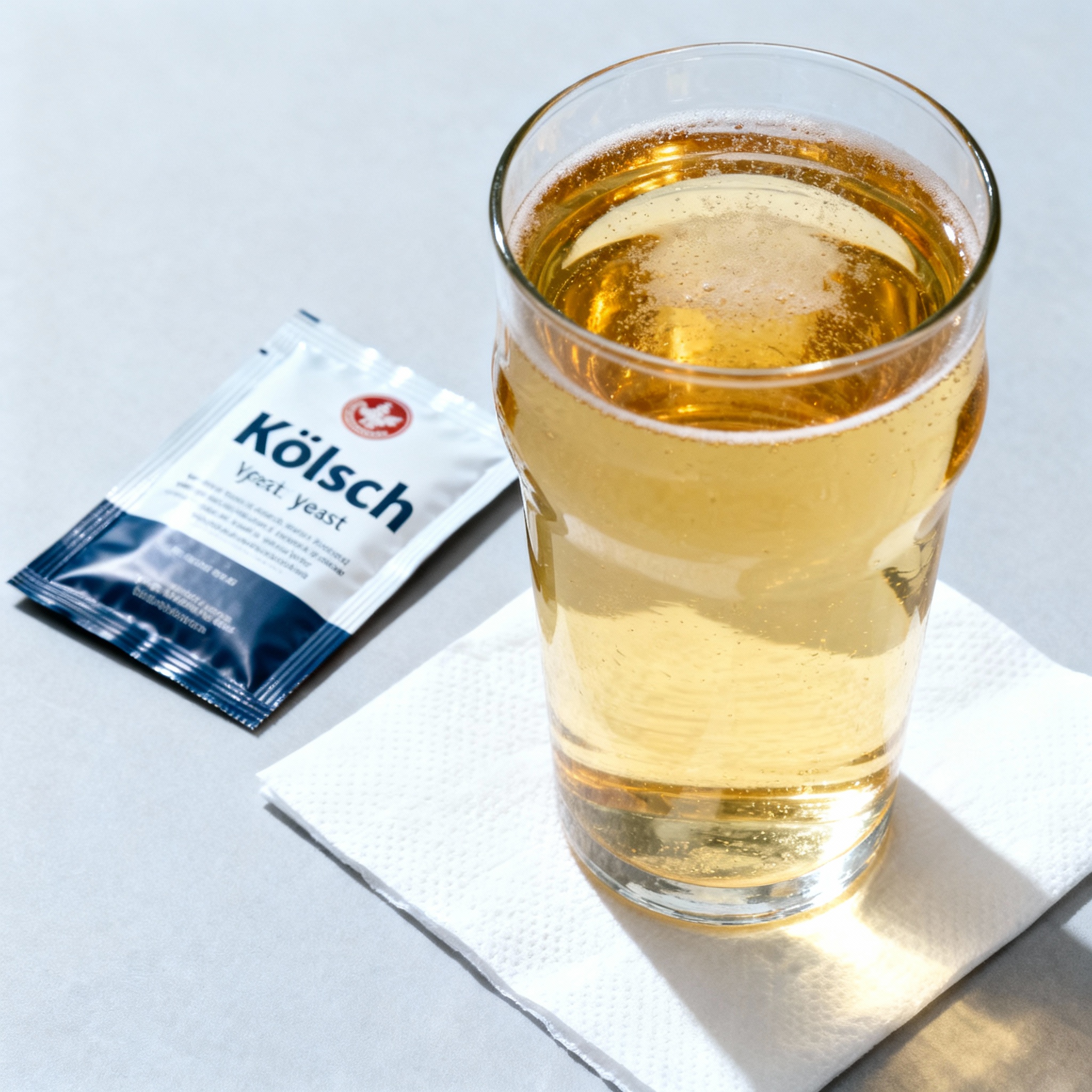
Kölsch yeast is a unique variant of Saccharomyces cerevisiae selected to ferment cold and finish bone-dry. (See attenuation and White Labs WLP029).
The magic happens at a narrow window of 58°F to 60°F. If you let Kölsch yeast ferment warm, it will throw esters and phenols that ruin the style’s signature restraint.
Fermenting at the lower end of the ale yeast’s range (14°C-15°C) suppresses the enzyme alcohol acetyltransferase. This limits the production of isoamyl acetate, preventing the banana and pear notes found in warmer fermentations.
Patience is required, as fermentation at 58°F can take 10 to 14 days to finish. Wait until the gravity stabilizes for three consecutive days before moving to the lagering phase.
Pitch twice as much yeast as you would for a normal ale (1.5 million cells/mL/°P). Kölsch yeast is sluggish at low temperatures, and a high pitch rate prevents stalled fermentations and sulfur off-flavors.
Lagering: Why an Ale Needs Four Weeks in the Cold
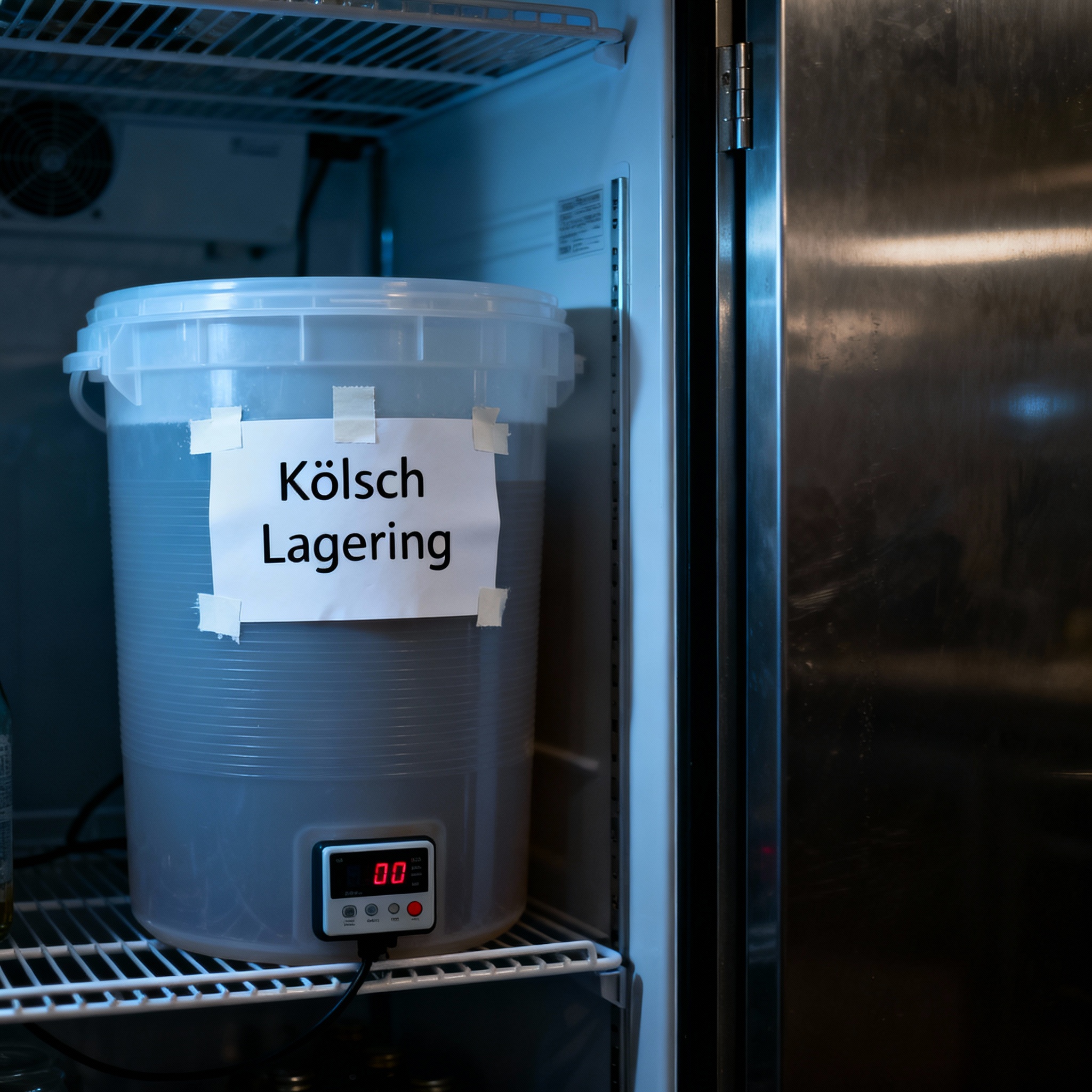
This is where most homebrewers fail: they skip the lagering phase. Lagering is German for “to store,” and for a Kölsch, this means a minimum of four weeks at 35°F to 40°F.
During this time, the yeast cleans up diacetyl, acetaldehyde, and sulfur compounds. The beer also drops sediment and clarifies naturally until it is brilliant.
One trick I’ve learned is to lager directly in the keg. Transfer the beer to a purged keg, seal it, and store it in the kegerator for the full duration.
If you see a small amount of yeast sediment at the bottom of the keg after lagering, don’t worry. Pour the first glass slowly to clear the line, and the rest of the keg will be crystal-clear.
The Look: Brilliant Clarity and Head Stability
Kölsch should be brilliantly clear, to the point where you can read text through the glass. This clarity is achieved through cold fermentation, long lagering, and a grain bill that avoids high-protein adjuncts.
The head must be white, dense, and persistent. If the foam collapses quickly, your mash pH was likely too high or your carbonation was insufficient.
Target carbonation for Kölsch is 2.5 to 2.7 volumes of CO2. Higher carbonation levels support the foam structure, while malted wheat (not flaked) adds stable proteins that enhance head retention without causing haze.
Cologne water is soft, so I use RO water and add back 50 ppm calcium and 50 ppm chloride. Avoid high sulfate levels, as they make hop bitterness too sharp for this delicate balance.
Serving: The Stange and Traditional Service
In Cologne, Kölsch is served in 200 mL glasses called Stangen. These tall, thin cylinders keep the beer cold and the head fresh by minimizing surface area.
The traditional service style involves a waiter (the Köbes) bringing continuous small pours until you place a coaster over your glass. This ensures the beer is always tasted at its freshest point.
At home, serve Kölsch at 40°F to 45°F. Colder temperatures mute the delicate malt sweetness, while warmer temperatures make the beer feel thin and flabby.
If you can’t find authentic Stangen, use a flute or a narrow pilsner glass. The tall shape is essential for preserving carbonation and displaying the beer’s clarity.
Recipe: Precision Parameters
Here is the base recipe for a 5-gallon batch at 1.048 OG. This is adapted from Gaffel Brewery standards and historical Cologne texts.
Grain Bill:
- 90% Pilsner Malt: I recommend Weyermann for authentic German character.
- 10% Wheat Malt: Enhances head retention without adding the haze of flaked adjuncts.
Mash:
- Single Infusion: 148°F to 150°F for 60 minutes.
- Target: A highly fermentable wort for a bone-dry finish.
Hops:
- Bittering: 1.5 oz Hallertau (4% AA) at 60 minutes (approx. 22 IBU).
- Flavor: 0.5 oz Hallertau at 15 minutes.
- Constraint: No late or dry hops; this style is not about hop aroma.
Fermentation & Lagering:
- Primary: 58°F for 10-14 days.
- Lagering: 35°F for 4 weeks.
Brew this recipe twice. The second time, you will dial in your system’s efficiency and temperature accuracy, which are the only ways to master this transparent style.
Conclusion
Kölsch teaches us that rules are the foundation of consistency. Without fruit puree or heavy hops to hide behind, you are left with only the basics: malt, water, hops, yeast, and temperature.
If you want a style that teaches you total control, brew Kölsch. It will show you every mistake you make, but once you get it right, it is one of the most satisfying beers in the world.
References
- Hieronymus, Stan. Brewing with Wheat. Brewers Publications, 2010.
- Palmer, J., & Kaminski, C. Water: A Comprehensive Guide. Brewers Publications, 2013.
- White, C., & Zainasheff, J. Yeast: The Practical Guide. Brewers Publications, 2010.
- Kölsch Konvention (1986). Köln, Germany.
- Noonan, Greg. New Brewing Lager Beer. Brewers Publications, 1996.
Kölsch Target Parameters
| Parameter | Target Range | Why It Matters |
|---|---|---|
| Original Gravity | 1.044 - 1.050 | Prevents heavy body or wateriness |
| Final Gravity | 1.008 - 1.010 | Mandatory high attenuation |
| IBU | 18 - 25 | Balanced bitterness, not hoppy |
| Color (SRM) | 3.5 - 5 | Pale gold, brilliant clarity |
| Carbonation | 2.5 - 2.7 vol | Supports foam and crisp mouthfeel |
| Lagering | 4 Weeks Min | Flavor maturation and natural fining |