Farmhouse Ales: Saison and Bière de Garde.
Introduction: Beer Made for Storage and Sustenance
I started brewing farmhouse ales because I was tired of throwing away batches that got too warm during fermentation.
My garage in Asheville hits 80°F in July, and most American ale yeasts turn into banana-soap factories above 72°F. Then I read about Belgian farmers who brewed in March and April, stored the beer in cool cellars, and drank it through the summer harvest.
No temperature control. No glycol chillers. Just yeast that could handle the heat and still taste clean.
Farmhouse ales are not delicate. They were brewed by people who had other jobs (like cutting wheat or feeding livestock).
The beer had to survive months in a cellar, taste good warm or cold, and sustain workers through 14-hour days in the fields. That means high carbonation for drinkability, dry finish so you don’t get bloated, and enough alcohol to stay stable without pasteurization.
There are two main branches of farmhouse brewing. Saison comes from Wallonia in southern Belgium.
It is dry, peppery, highly carbonated, and often golden. Bière de Garde comes from French Flanders, just across the border.
It is maltier, amber to brown, and traditionally lagered (cold-conditioned). Both are harvest beers.
Both use simple ingredients. Both taste like they were brewed in a barn (because they were).
This guide is about brewing them at home without pretending you have a commercial facility. I will walk you through the yeast, the sugar, the wild variations, and the serving.
If you want to brew a beer that tastes like it came from a 1920s farmhouse in Hainaut, this is how you do it.
Saison: The Dry, Peppery Belgian Ale
Saison is defined by one thing: dryness. A good saison finishes at 1.002 or lower.
That means almost all the sugar has been eaten by the yeast. You are left with carbonation, spice, and a ghost of malt.
This is not a sweet beer. Traditional saisons were 6% to 8% ABV because farmworkers needed calories and a little buzz to get through the day.
The most famous saison yeast is the Dupont strain (Wyeast 3724 or White Labs WLP565). It is a nightmare for beginners and a masterpiece for people who understand it.
The yeast stalls. It sits at 1.035 for three days and you think it is dead. (Typical behavior of Dupont yeast).
Then, if you raise the temperature to 85°F or 90°F, it wakes up and chews through the rest of the sugars like a wood chipper. I have had batches stall at 1.030, and I moved the carboy into my car on a hot afternoon.
Two days later, it dropped to 1.004. The flavor profile is black pepper, clove, lemon peel, and hay.
You do not get this from hops; you get it from the yeast working hot and hungry. The grain bill is simple, using Pilsner malt, a little Munich or Vienna, and maybe some wheat for head retention.
Farmers did not have access to 47 specialty malts. They used what they grew.
Hops are low and earthy. Saaz, Styrian Goldings, or East Kent Goldings work.
You are aiming for 20 to 30 IBUs. The bitterness is there to balance the dry finish, not to dominate.
Fermentation is where most people fail. Start at 68°F and let it sit for two or three days.
When the airlock slows down, raise the temperature. I wrap the carboy in a heating pad and let it climb to 85°F.
The yeast will finish the job. Do not rush it and do not panic, as Dupont yeast takes time.
If you want a faster alternative, try French Saison (Wyeast 3711). It ferments clean, finishes dry, and does not stall.
If your saison stalls, add 100 grams of table sugar dissolved in warm water. The simple sugar will wake the yeast up; I have done this six times and it worked every time.
Bière de Garde: The Maltier French Cousin
Bière de Garde means “beer for keeping.” It was brewed in late winter or early spring, then stored in cold cellars until summer.
Unlike saison, which is brewed warm and fast, Bière de Garde is brewed cool and slow. The French used lager techniques even before lager yeast was isolated.
They fermented with ale yeast, then dropped the temperature and aged the beer for months. The grain bill is heavier, using Vienna malt, Munich malt, and aromatic malt.
Some recipes use a touch of Special B for raisin and plum notes. The color ranges from pale gold (Blonde) to deep amber (Ambrée) to brown (Brune).
The yeast is where it gets interesting. Traditionally, French brewers used mixed-culture fermentation.
Modern Bière de Garde is cleaner. You can use a Belgian ale yeast like Wyeast 1214 or a French ale strain like Wyeast 3725.
Fermentation starts at 65°F. Let it go for a week, then drop the temperature to 50°F or lower.
This is called lagering. It clears the beer, softens the flavors, and lets the malt complexity shine.
I brew Bière de Garde in November and December when my garage stays cold. I rack the beer into a secondary fermenter, seal it, and leave it in the corner for six weeks.
Hops are subtle. Styrian Goldings or French Strisselspalt are traditional.
You want 18 to 25 IBUs. The bitterness is a whisper, not a shout, because the malt is the star here.
If you do not have a way to lager at 50°F, just ferment at 62°F and let it sit at room temperature for an extra two weeks. It will not be as clean, but it will still taste like a farmhouse beer.
The Sugar Usage: Beet Sugar for Attenuation
Belgian and French farmhouse brewers did not use fancy ingredients. They used what was cheap and available.
In northern France and Belgium, that meant beet sugar. Adding sugar to beer does two things.
First, it boosts the alcohol content without adding body or sweetness. Second, it dries out the beer. (See attenuation).
A 6% saison made with 100% malt will finish at 1.010 and taste thick. A 6% saison with 15% sugar will finish at 1.002 and taste crisp. (See beet sugar history).
I add sugar at the end of the boil. I boil 500 grams of table sugar in a liter of water for five minutes to sterilize it, then pour it into the fermenter.
Troubleshooting the Stall
The Dupont strain is a masterpiece, but it can be frustrating. If your gravity stops moving in the 1.030 range, follow this protocol to get it back on track.
📉 The "Dupont Stall" Rescue Protocol
      graph TD
      A['Gravity Stuck at 1.030?'] --> B['Wait 3 Days']
      B --> C['Current Temp Check']
      C -->|'Below 80F'| D['Heat to 90F']
      C -->|'Above 80F'| E['Use Foil Lid']
      D --> F['Activity Check']
      E --> F
      F -->|'No'| G['Add Sugar Slurry']
      G --> H['Activity Check']
      H -->|'No'| I['Re-pitch 3711']
      H -->|'Yes'| J['Finish to 1.002']
      I --> J
*Note: The Dupont strain is highly sensitive to CO2 backpressure and temperature drops.
Do not add it during the mash. Add it at the start so the yeast can plan its metabolism accordingly.
The amount depends on the style. For saison, I use 10% to 20% of the total fermentables as sugar.
For Bière de Garde, I use 5% to 10%. You can also use Belgian candi sugar, but table sugar is what Belgian brewers used for 200 years.
Some people worry that sugar makes beer taste thin or alcoholic. That is only true if you use too much or pair it with the wrong yeast.
A saison yeast like Dupont creates enough phenols and esters to cover the alcohol heat. Match the sugar to the yeast.
If you do not have a scale, 1 cup of white sugar weighs about 200 grams. For a 5-gallon batch, 2 cups (400 grams) is a safe starting point.
Wild Variation: The Role of Brettanomyces
Not all farmhouse ales are clean. In fact, most traditional farmhouse beers were not clean.
They were fermented with whatever yeast was living in the barrels and the air. That often included Brettanomyces (Brett), a wild yeast that smells like leather, hay, and barnyard.
Modern American craft brewers treat Brett like a fancy ingredient, but in Belgium and France, it was just part of the process. You did not add it on purpose; it showed up because your equipment was not sterile.
There are two ways to approach wild farmhouse brewing. The first is to pitch Brett along with your primary yeast.
I use Wyeast 3726 or White Labs WLP670, which already contains Brett. You ferment at normal temperatures, and the Brett slowly takes over.
The second way is to age your beer in a carboy that previously held a Brett beer. I have a glass carboy that I only use for wild fermentation.
I rinse it with hot water and let it dry. Every batch I brew in that carboy picks up a little Brett from the previous batch.
The risk with Brett is that it never stops eating. If you bottle too early, your bottles will explode.
I wait until the gravity has been stable for four weeks before bottling. I also use champagne bottles that can handle high pressure.
If you want to experiment with Brett but do not want to commit, brew a small 1-gallon batch. Pitch the Brett, wait six weeks, and taste it; if you hate it, you only wasted a gallon.
Serving: Carbonation and Glassware
Farmhouse ales are highly carbonated. Saison should have 3.5 to 4 volumes of CO2, which is champagne-level carbonation.
Bière de Garde is slightly lower, around 2.5 to 3 volumes. This high carbonation makes the beer feel light and refreshing even though it is 7% ABV.
It also enhances the yeast-derived flavors like pepper and fruit. I bottle-condition all my farmhouse ales.
I add priming sugar at bottling time and let the yeast carbonate the beer in the bottle. For saison, I use 9 to 10 grams of dextrose per liter.
For Bière de Garde, I use 6 to 7 grams per liter. Glassware matters.
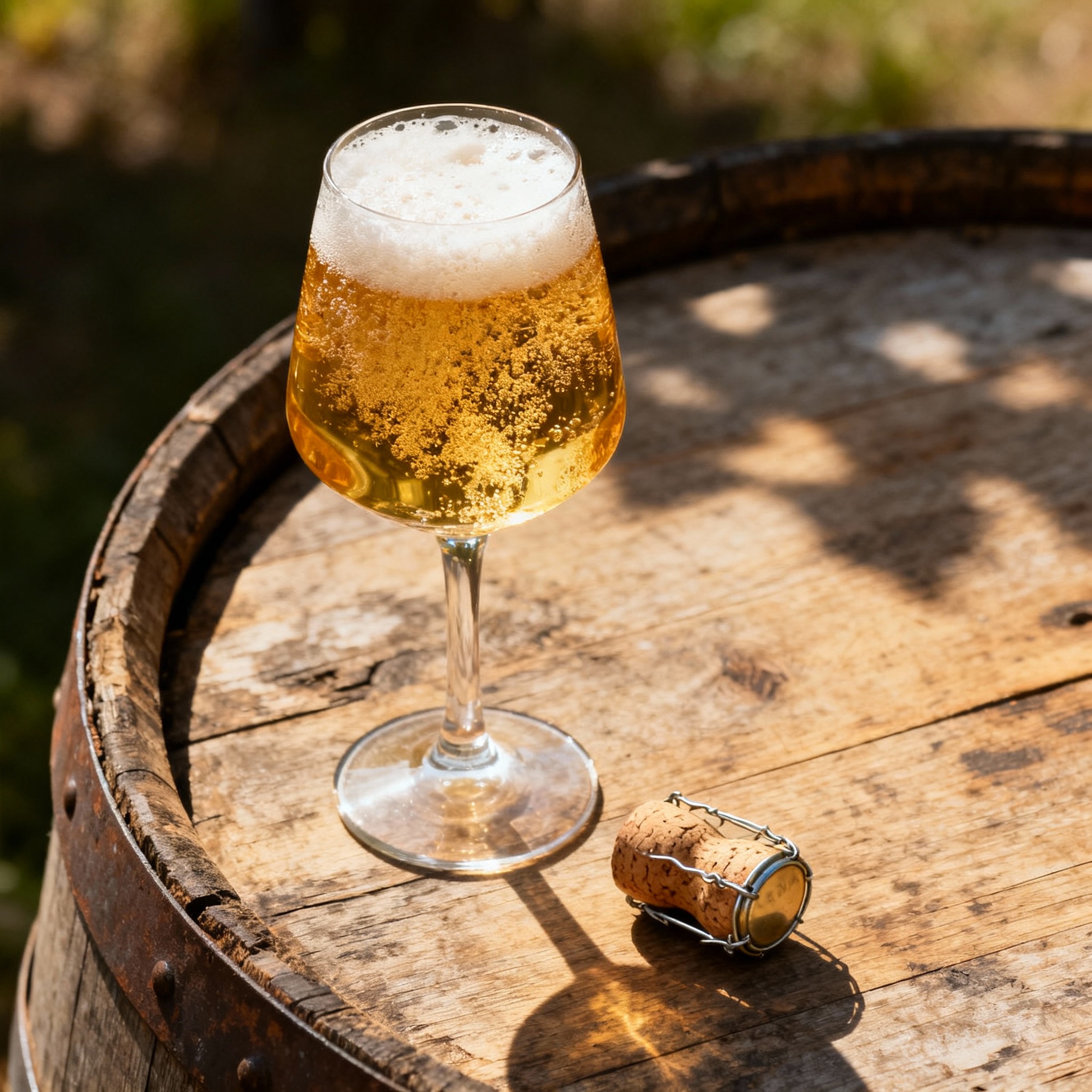
Saison should be served in a tulip glass or a stemmed goblet. The shape concentrates the aromatics and gives room for the big foam head.
Temperature matters too. Saison is best at 45°F to 50°F.
Bière de Garde can go a little warmer, 50°F to 55°F, because the malt flavors open up with warmth. Pour the beer hard to get a big foam head.
If you pour it gently, the carbonation stays trapped and you get a bloated feeling. A proper farmhouse ale should have two fingers of foam that lasts until the end of the glass.
If your saison is under-carbonated, let the bottles sit at room temperature for another week. If it is over-carbonated, chill the whole case and drink it fast.
Conclusion
Farmhouse ales are not complicated. They are the opposite of complicated.
You take simple ingredients, ferment them warm or cold, let the yeast do the work, and drink the result. You do not need a pH meter or a glycol chiller.
You need good yeast, patience, and a garage that stays above freezing. I have brewed saisons in the summer with no temperature control and they turned out great.
I have brewed Bière de Garde in the winter and forgotten about them for three months, and they were excellent. The key is to stop overthinking it.
Farmers did not have spreadsheets or online forums. They had grain, water, yeast, and time.
Your version does not have to be perfect. It just has to taste good.
Farmhouse Grain Bill: Bière de Garde Variants
This table outlines the foundational grist compositions required to hit the specific color and flavor profiles of the Blonde, Ambrée, and Brune variants.
| Ingredient / Metric | Blonde (Golden) | Ambrée (Amber) | Brune (Brown) |
|---|---|---|---|
| Pilsner Malt | 80-90% | 60-70% | 50-60% |
| Munich / Vienna | 5-10% | 20-25% | 20% |
| Crystal / Caramel | 0% | 5-10% (Mid-range) | 10% (Dark/Special B) |
| Roasted Malts | None | None | 2-5% (Chocolate/Black) |
| Sugar (Sucrose) | 5-10% | 5% | 5% |
| Target OG | 1.060 - 1.075 | 1.060 - 1.075 | 1.065 - 1.080 |
| Color (SRM) | 6 - 9 | 12 - 19 | 20 - 30 |
Traditional Bière de Garde focuses on Maillard reaction products rather than hop character. Using a high-quality continental Munich malt is essential for achieving the “toasty” backbone characteristic of the style.
Technical Grist Considerations
A high-quality, modified Pilsner malt provides the crisp, fermentable base necessary for these styles. This prevents high-gravity finishes from becoming cloying or overly sweet during the extended lagering period.
Clear or amber Candi sugar is frequently added to boost the alcohol content. This technique maintains a light body and high drinkability despite the increased alcohol concentration.
For the Blonde variant, consider adding 5% Wheat or Carapils to enhance head retention. This provides necessary protein for foam stability without altering the pale color profile.
References
- Hieronymus, S. (2005). Brew Like a Monk. Brewers Publications.
- Markowski, P. (2004). Farmhouse Ales. Brewers Publications.
- Rajotte, P. (1992). Belgian Ale. Brewers Publications.
- Wyeast Laboratories. Technical Data Sheet for 3724 Belgian Saison.
- White Labs. WLP565 Technical Specification and Fermentation Chart.