The Water Day Workflow: Salts, Acid, and Campden
You have a recipe, malt, and hops, but you also have a stack of white powders that require a specific addition order. Ignoring your water is like ignoring the foundation of a house; if the base is wrong, nothing else sits right.
I spent my first three years brewing without touching water chemistry until a pale ale tasted like cardboard and swimming pool water. That was the day I realized that managing ions and pH is a non-negotiable part of the “garage lab” process.
This guide walks you through the physical checklist I follow every time I brew. It keeps me from dumping salts into the wrong vessel or forgetting to pH-test the mash until it’s too late to fix it.
Source Water Prep: Killing the Chlorine
Before adding anything to your water, you must neutralize chlorine and chloramine used by municipalities. When these meet malt phenols, they create chlorophenols, which taste like medicinal plastic or Band-Aids.
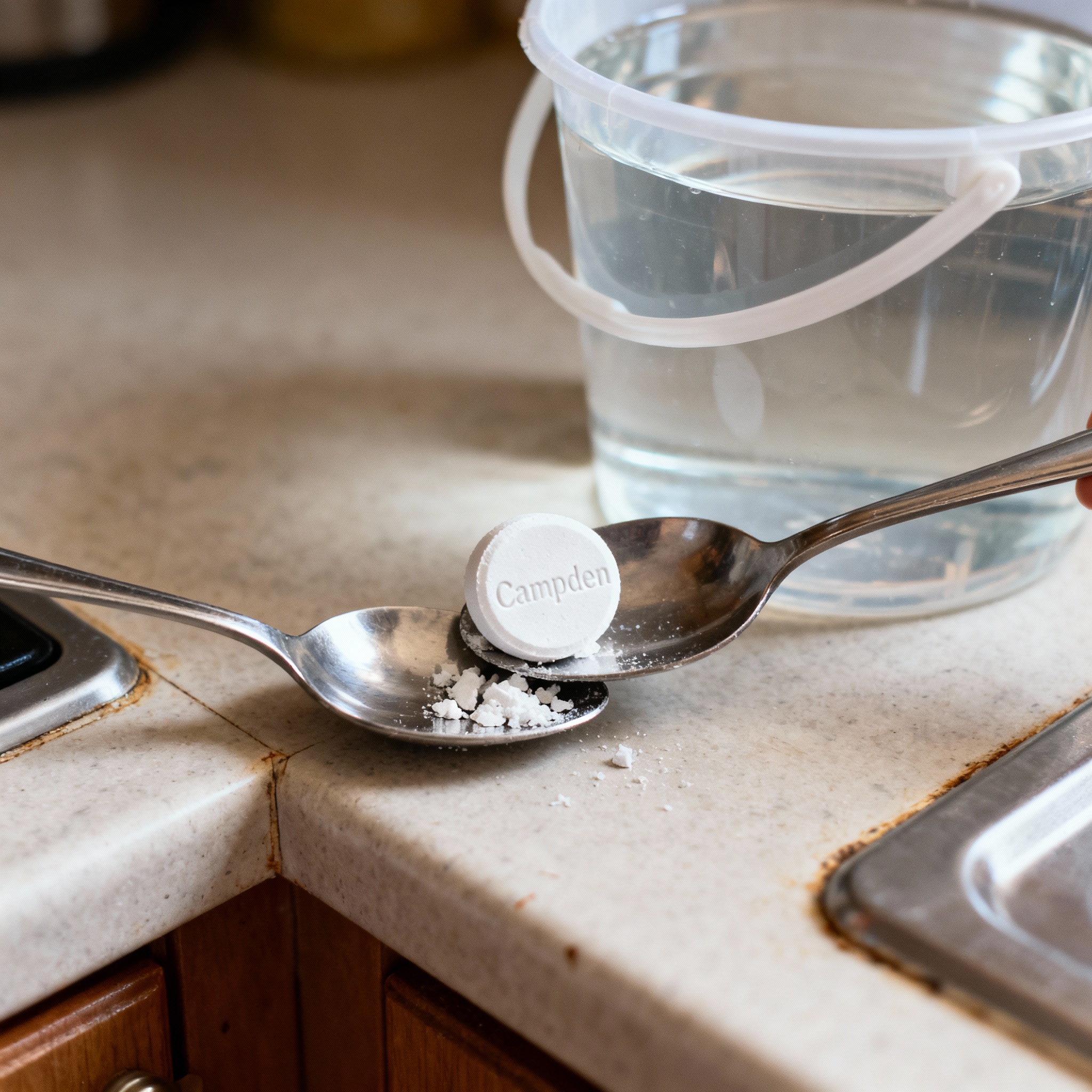
I use Campden tablets because they’re cheap, fast, and highly reliable. One tablet treats 20 gallons of water.
I crush half a tablet, dissolve it in a small cup, and stir it into the brew kettle right after I fill it. Within two minutes, the chlorine is neutralized, providing a clean slate for the rest of the chemistry.
If you’re brewing with distilled or reverse osmosis (RO) water, you can skip this step entirely. There is no chlorine in distilled water, which is why I use it for delicate lagers.
Weighing Salts: Precision measurement
You cannot eyeball salts because different minerals have different densities. Gypsum is lighter and fluffier than calcium chloride dihydrate, meaning a teaspoon of one is not the same weight as the other.
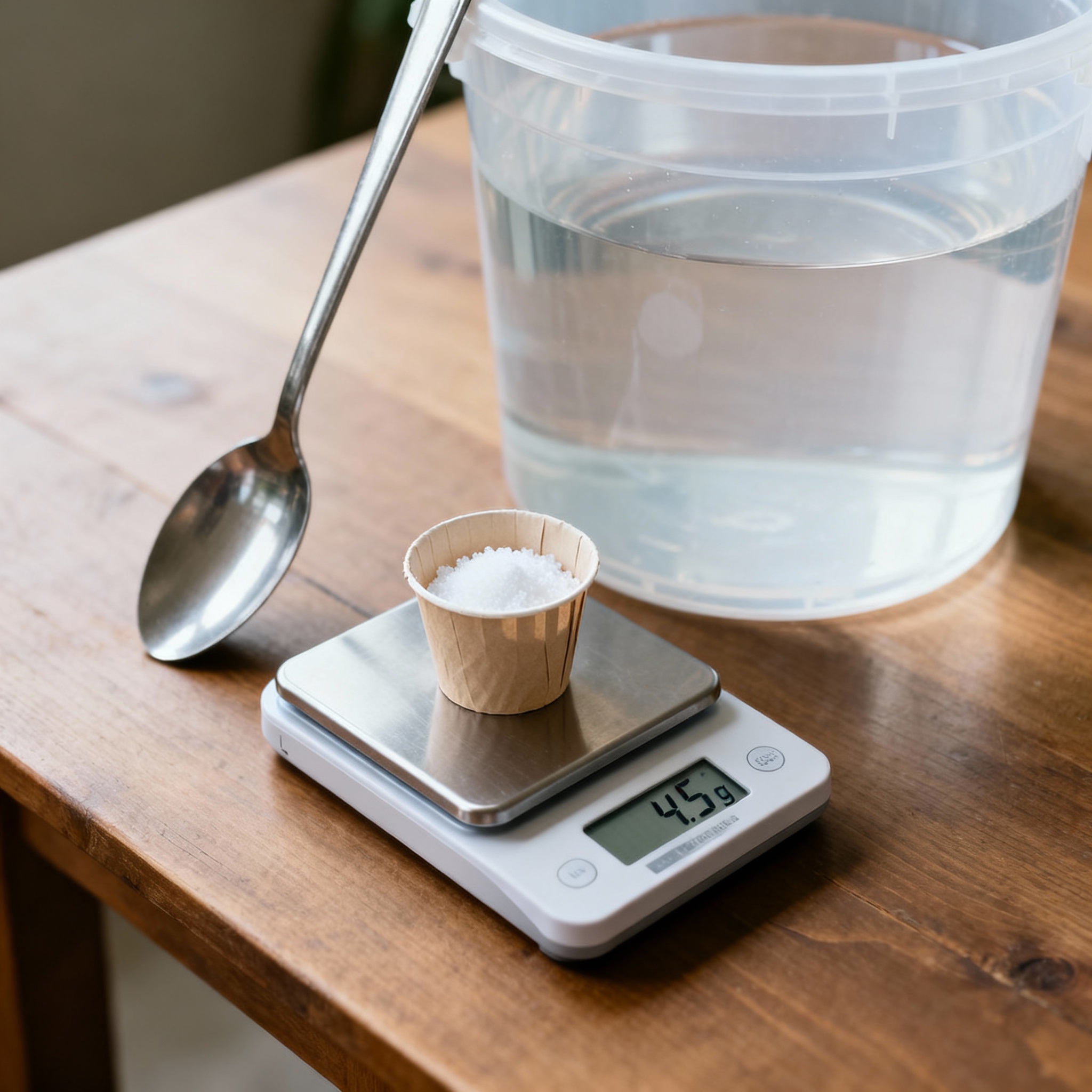
I use a digital gram scale that measures to 0.1 grams. I zero the scale with a small plastic cup and pour the powder until I hit the exact gram count required by my calculator.
I weigh each salt into a separate cup and label them with a Sharpie. Calcium chloride dihydrate is hygroscopic and absorbs moisture from the air, so I store it in a sealed mason jar and work quickly to avoid clumping.
If your calcium chloride has clumped into a solid mass, break it up with a fork before weighing. Loose powder dissolves faster and ensures you aren’t under-dosing due to internal moisture weight.
Mash vs. Boil Additions: Strategic Placement
You don’t dump all your salts into the same place. Salts added to the mash affect pH and enzyme activity, while salts added to the boil primarily affect flavor.
Calcium is the most important ion for mash pH. It reacts with malt phosphates to pull the pH down into the 5.2 to 5.6 range where enzymes work most efficiently.
Calcium ions () react with the phytin and secondary phosphates released by the malt to precipitate calcium phosphate (). This reaction releases hydrogen ions (), which directly lowers the mash pH and improves alpha-amylase activity.
Magnesium sulfate (Epsom salt) can also lower pH slightly, but I mostly use it for sulfate additions in IPAs. If I’m adding more than 2 grams, I split the dose between the mash and the boil to avoid a harsh, metallic aftertaste.
Sodium chloride (table salt) goes in the boil. It doesn’t affect pH much and serves as a flavor addition to enhance sweetness and body in malty styles like Scottish ales.
If you’re doing a full-volume BIAB mash, add all your salts to the full water volume before heating. If fly sparging, only treat the mash water with salts; sparge water requires a different approach.
Acidifying the Mash: The 15-Minute pH Check
Even with the correct salt additions, your mash pH might not land in the target window. This is where 88% lactic acid becomes a vital tool.
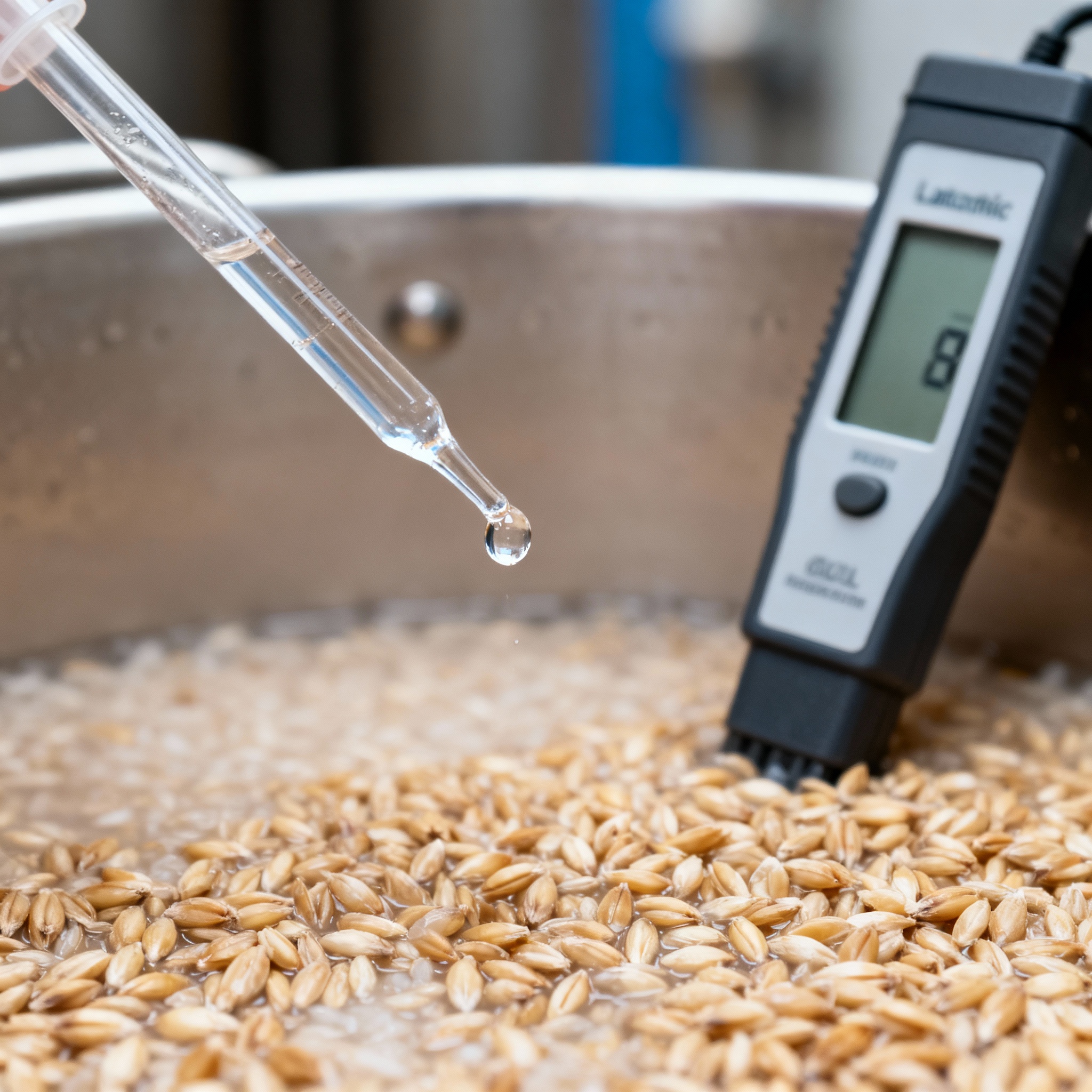
I measure mash pH at the 15-minute mark. I pull a small sample, let it cool to room temperature (77°F), and dip my pH meter in.
If the reading is above 5.6, I add lactic acid using a 1 mL syringe. I stir thoroughly, wait 5 minutes, and retest until I hit the 5.2 to 5.6 range.
Do not overshoot. Lactic acid lowers pH rapidly, and bringing the mash below 4.9 will result in a thin, sour beer and broken enzymatic conversion.
If you don’t own a pH meter, you can use pH strips, but they are significantly less precise. A digital meter is worth the investment for the 0.1-0.2 accuracy difference.
Sparge Water Acidification: Tannin Prevention
If you fly sparge, you must acidify your sparge water separately. As you rinse the grain bed, the pH rises; if it climbs above 6.0, you start extracting astringent tannins from the grain husks.
I acidify my sparge water to a pH of 5.5 or lower before I start the process. It usually takes 2 to 4 mL of lactic acid for 3 gallons of sparge water to neutralize the alkalinity.
Do not add salts to your sparge water. Salts in the sparge can over-extract tannins even if the pH is in the correct range.
If you forget to acidify your sparge water and realize halfway through, stop immediately and acidify the remaining volume. It is better to finish with a lower volume than to ruin the batch with harsh astringency.
Putting It All Together
The workflow begins with filling the kettle and adding a Campden tablet. While that sits, I weigh and label my salts before adding mash salts to the strike water.
At 15 minutes into the mash, I pull a sample and adjust pH with lactic acid. While the mash continues, I heat and acidify the sparge water in a separate vessel.
During the boil, I add the flavor salts (NaCl). Once the boil is finished, I chill, transfer, and pitch yeast.
This workflow adds about 15 minutes to the day, but it is leveraged effort from water chemistry. My pale ales are crisper, my stouts are rounder, and my lagers have lost that wet cardboard character.
Brew Day Water Checklist
| Step | Action | Timing | Target |
|---|---|---|---|
| Chlorine Removal | 0.5 Campden tablet per 10 gal | Post-fill | Neutral water |
| Weigh Salts | Use gram scale; label cups | Pre-mash | Precision dosage |
| Mash Additions | Add Gypsum/CaCl2 to strike | Pre-dough in | pH/Enzyme prep |
| Mash pH Check | Cool sample; adjust w/ acid | 15 min mark | 5.2-5.6 pH |
| Sparge Acid | pH to 5.5 or lower | Pre-sparge | No tannins |
| Boil Salts | Add flavor salts (NaCl) | 60 min mark | Flavor profile |
References
- Palmer, J., & Kaminski, C. Water: A Comprehensive Guide for Brewers. Brewers Publications, 2013.
- Troester, M. “The Effect of Brewing Water Chemistry on Beer Flavor.” Braukaiser.com, 2009.
- UC Davis. “Water Quality for Crop Production.” Department of Land, Air and Water Resources, 2018.